Welcome to the Xen Project Community Planet

The latest updates from around the Xen Project ecosystem.

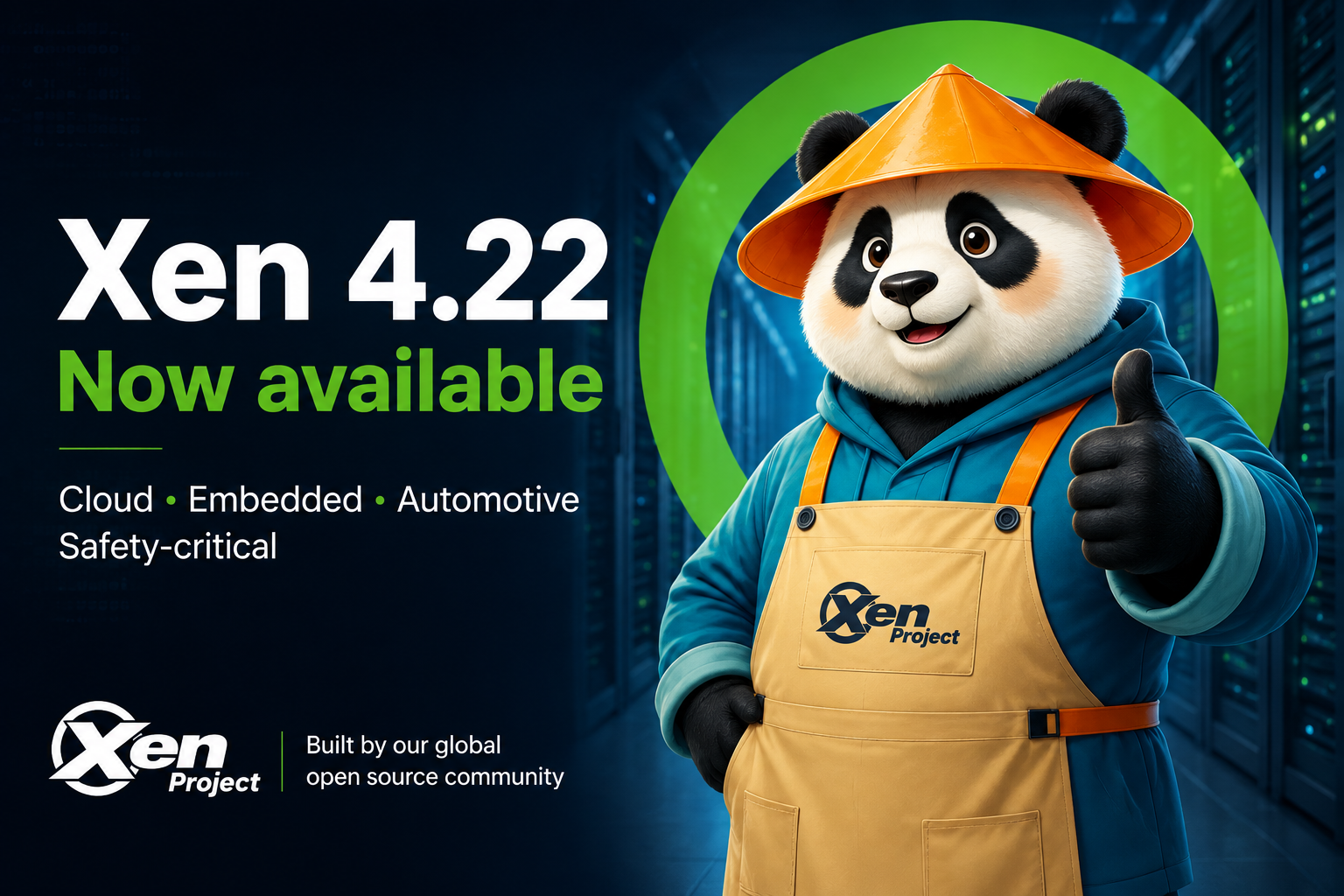
  • Xen 4.22: Strengthening Open Source Virtualization for Cloud, Embedded, and Automotive Systems 05 August

    Xen 4.22: Strengthening Open Source Virtualization for Cloud, Embedded, and Automotive Systems

    We are excited to announce the availability of Xen 4.22, the latest release of the Xen hypervisor. Xen 4.22 brings improvements across hardware support, scalability, and platform capabilities while continuing Xen's evolution as a trusted open source virtualization foundation for cloud, embedded, automotive, and safety-critical systems.

    The release reflects the continued collaboration of developers, maintainers, and industry partners working together to advance virtualization in the open.

    A more predictable support lifecycle

    Alongside the Xen 4.22 release, the Xen Project continues its commitment to long-term maintenance with an updated stable branch support policy.

    Xen 4.20 and later releases receive:

    • Three years of full support, including bug fixes and security fixes
    • Two additional years of security-only support
    • Five years of security support in total

    This change better aligns Xen's support model with the expectations of industries where products require long-term security maintenance, including embedded and automotive deployments.

    Historically, Xen releases received approximately 18 months of full support, followed by security-only maintenance for up to three years from the original release. The updated policy extends full support to three years and total security support to five years.

    Because the same lifecycle applies to every release, the project is intentionally not introducing separate LTS-branded branches. This gives users a consistent and predictable maintenance model without changing Xen’s release cadence.

    What’s new in Xen 4.22

    AMD Zen 5 support

    Xen 4.22 adds support for AMD Zen 5 Bus Lock Threshold, helping protect system performance and responsiveness in virtualized environments. Bus locks caused by certain atomic operations can affect performance across an entire system. The new threshold support gives administrators greater control over how these situations are handled on modern AMD platforms.

    Continued improvements for Arm

    Arm has been a supported Xen architecture for many years. Xen 4.22 continues to improve Arm virtualization capabilities with enhancements including:

    • PSCI suspend and resume support: Improves standards-based guest power management.
    • FF-A updates: Improve communication with secure-world firmware and services.
    • Armv8-R MPU work: Continues Xen's development for real-time and safety-critical systems without a traditional memory management unit.

    Continued progress on RISC-V

    Xen’s RISC-V port remains under active development as the community works toward full guest virtualization. Xen 4.22 adds internal support for the SSTC timing extension and introduces domain-building helpers that simplify the creation of guest domains using device trees. These are foundational improvements rather than a claim of production-ready RISC-V virtualization.

    Xenstore improvements

    Xen 4.22 introduces per-domain Xenstore quotas and watch-depth limits. These controls help prevent an individual guest from consuming excessive Xenstore resources and improve robustness in larger deployments.

    Codebase modernization

    Xen 4.22 also continues the long-term modernization of the hypervisor by removing deprecated interfaces and reducing technical debt. This work may be less visible than a new hardware feature, but it makes the codebase easier to maintain, review, and extend.

    Built by the Xen community

    Every Xen release is the result of collaboration across companies, organizations, and individual contributors. Developers review patches, test hardware, improve documentation, and solve problems together through an open development process.

    Thank you to everyone who contributed code, reviews, testing, documentation, feedback, and persistence to Xen 4.22.

    Want to join us and help build the future of open source virtualization? Join our Matrix channels and mailing lists.

    Want to meet the people building Xen? Join the community at Xen Summit 2026 in Munich, September 15-17.
    Resources

  • Xen at FOSDEM: Real-World Conversations About Xen and KVM 04 February

    Xen at FOSDEM: Real-World Conversations About Xen and KVM

    We just wrapped up a weekend at FOSDEM 2026 where Xen and XCP-ng both had dedicated booths. This was my first time at FOSDEM and the legend lived up to the hype.

    It was an insightful weekend full of interesting folks who were genuinely interested in the Xen Project. Everything from folks who used Xen 20 years ago, folks who know Xen of today, and folks who had limited insight into why hypervisors are important.

    By far, the most common question I received was, “How is Xen different from KVM or Proxmox?” Those are actually two separate questions, and they are worth taking one at a time.

    First, Proxmox (Proxmox VE) is a virtualization solution built on top of the KVM hypervisor. Xen, on the other hand, is a hypervisor. To make a fair comparison with Proxmox, you really want to compare it with a Xen-based virtualization solution, such as XCP-ng. Under the hood, what we are really comparing is KVM versus Xen.

    To compare these two hypervisor technologies, it helps to understand the different types of hypervisors: Type 1 and Type 2. A Type 2 hypervisor runs on top of a host operating system. Common examples include VirtualBox and Parallels.

    In contrast, a Type 1 hypervisor runs directly on the hardware, with no host operating system sitting between the hypervisor and the hardware. KVM is implemented as a set of kernel modules and runs in kernel space. For that reason, it is often described as a Type 1 hypervisor. At the same time, KVM depends on the full Linux kernel for scheduling, memory management, drivers, and device support, along with everything that comes with that.

    Xen is what we often refer to as a “true” Type 1 hypervisor. The Xen hypervisor boots directly on the hardware and does not depend on the Linux kernel. Linux is commonly used in a privileged control domain, known as Dom0, but it is not required for Xen itself to function.

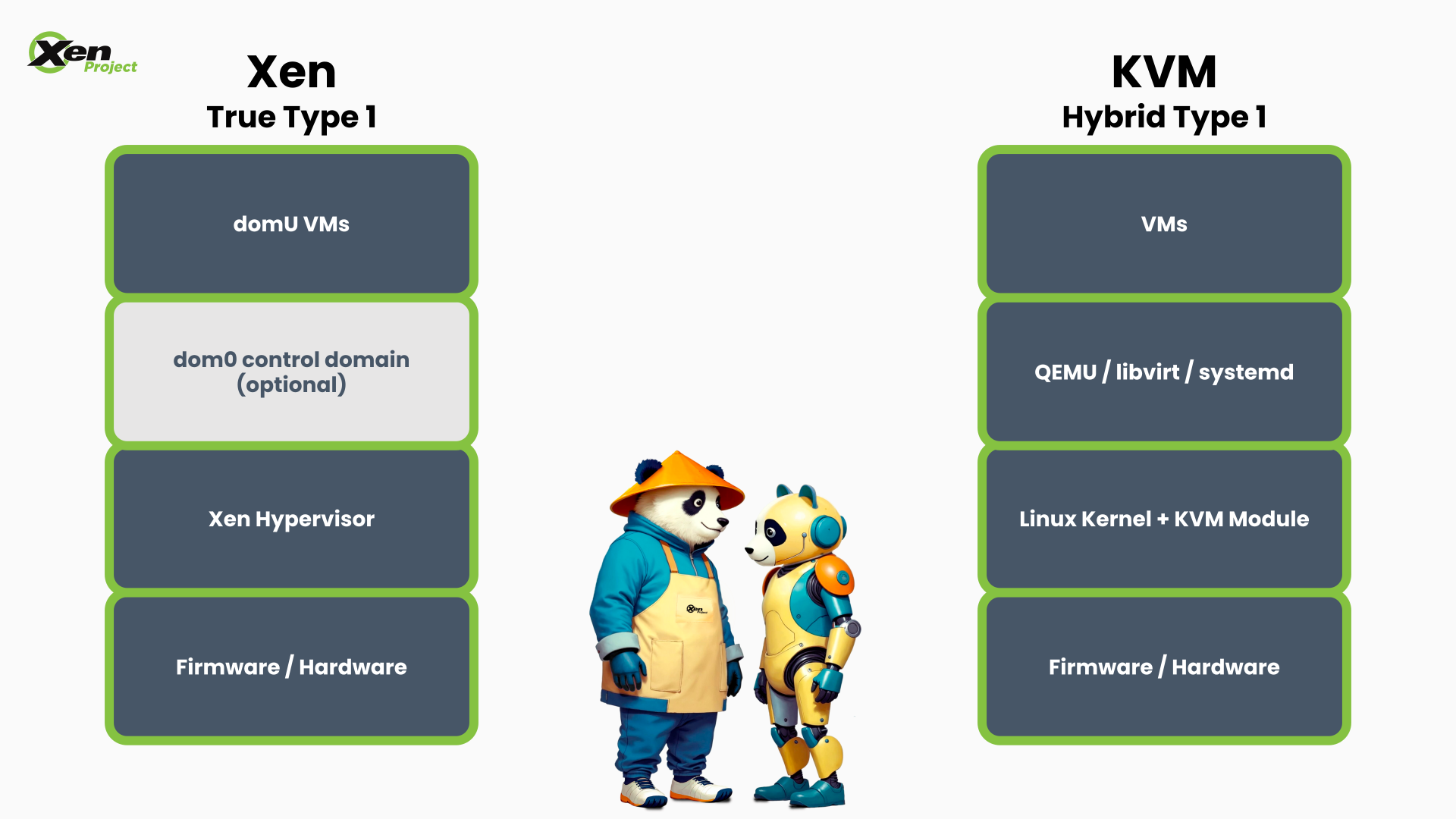
    At a high level, the architectural difference looks like this:

    Xen at FOSDEM: Real-World Conversations About Xen and KVM
    Xen and KVM architecture at a high level. Xen runs as a small, dedicated hypervisor directly on the hardware, with an optional control domain (Dom0). KVM operates as part of the Linux kernel and relies on the full Linux stack and user space components to manage virtual machines.

    What does this mean in practice? Xen offers a very small, purpose-built hypervisor layer. In some workloads, this can translate into more predictable performance and stronger isolation, because the hypervisor is not competing with a general-purpose operating system kernel at the same layer. Xen also has fewer lines of code in the hypervisor itself, which reduces the attack surface and the amount of code that needs to be audited and maintained. There are also fewer dependencies to update when updating the hypervisor.

    Another common question I heard was, “What about scheduling processes? Xen must be missing the Linux kernel scheduler.” That’s true. Xen does not rely on the Linux scheduler. Instead, Xen has its own CPU schedulers that are specifically designed for virtual machines.

    At a high level, Xen distinguishes between physical CPUs (pCPUs), which are the actual cores on the machine, and virtual CPUs (vCPUs), which are presented to guest VMs. Xen can dedicate physical CPUs to specific VMs using CPU pinning, ensuring that a VM runs only on a defined set of cores. Xen can also expose vCPUs that are scheduled onto shared physical CPUs, allowing multiple VMs to share CPU resources in a controlled way.

    Xen supports several scheduling algorithms depending on the use case. These include general-purpose schedulers such as Credit and Credit2, which aim to fairly share CPU time across VMs, as well as real-time schedulers like RTDS for latency-sensitive and deterministic workloads. This flexibility allows operators to choose between throughput, fairness, or predictability depending on their needs.

    If we look at the embedded space, this is where Xen’s architecture really shines, though it is not limited to embedded environments. In safety-critical applications, such as automotive systems, the smaller Xen hypervisor codebase means fewer lines of code that need to be audited and certified. Members of the Xen Project are actively working toward safety certification goals. By comparison, certifying KVM together with the full Linux kernel is a much larger undertaking and may not always be worth the investment. Today, the community’s expectation is that Xen can achieve safety certification for certain automotive use cases on a timeline around 2026 or 2027. Fewer lines of code also mean faster certification cycles and simpler long-term maintenance, including security updates.

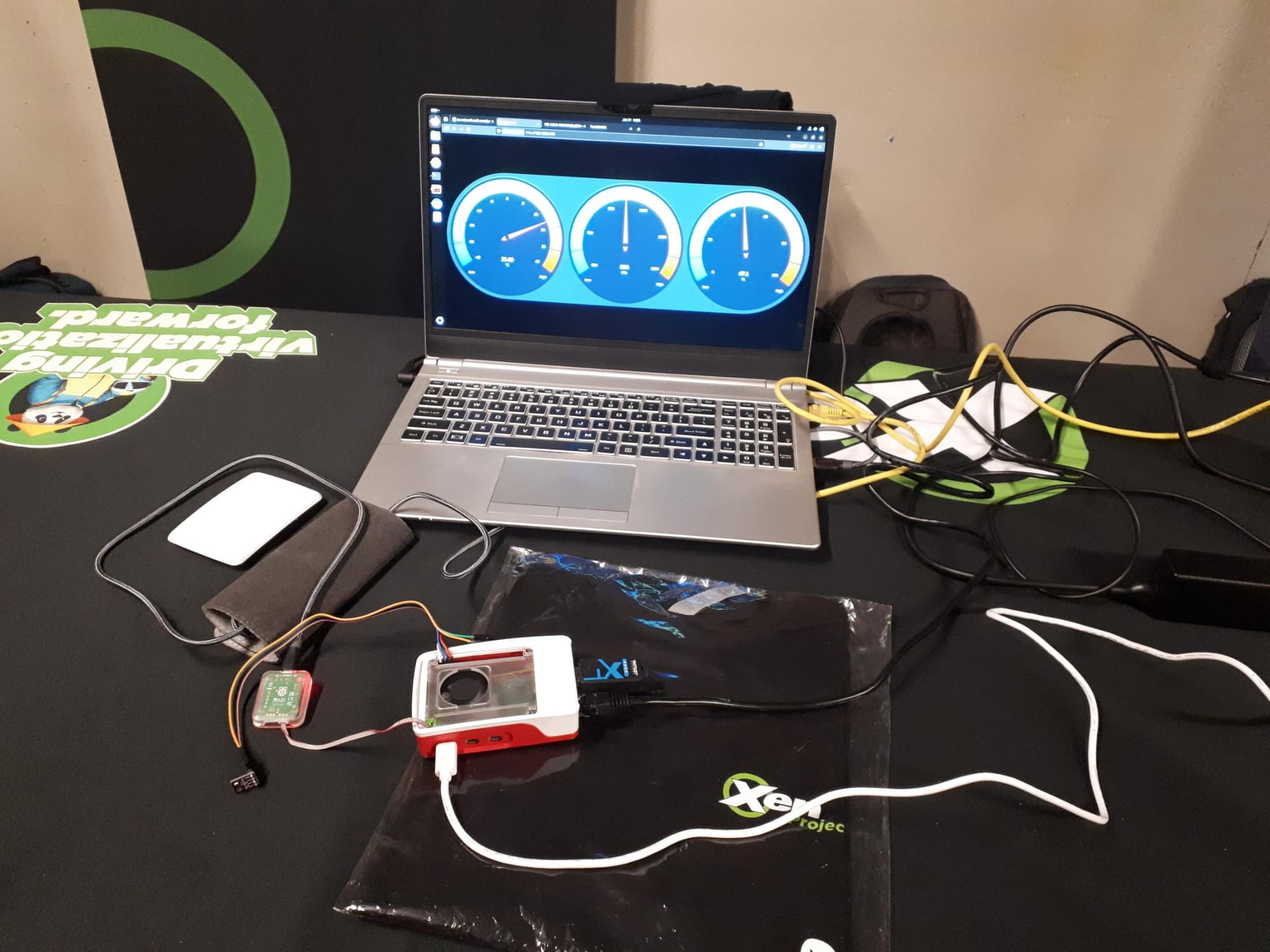
    At the booth, I also had a small proof of concept running to make this more tangible. The demo showed an automotive-oriented workload running on a consumer embedded device, using Xen to isolate and manage multiple domains. While still a work in progress, it sparked a lot of good conversations about how Xen can be used in constrained environments with mixed-criticality and as a foundation for safety-critical systems.

    Xen at FOSDEM: Real-World Conversations About Xen and KVM
    Automotive-oriented Xen proof of concept running on a consumer embedded device at FOSDEM 2026.

    Overall, Xen has a clean, built-for-purpose architecture for virtualization. The Xen hypervisor itself does not depend on the Linux kernel, and that architectural choice is what sets Xen apart from Proxmox and other KVM-based solutions. You get a purpose-built hypervisor designed from the ground up for isolation, configurability, and security, with fewer lines of code and fewer moving parts at the lowest level.

    Come and see what we are working on at the Xen Project. We’re a Linux Foundation project with open governance, supported by a broad set of members and contributors from across industry and academia. Whether you are running Xen today, evaluating virtualization technologies, or exploring safety-critical and embedded use cases, we’d love to hear from you. Join the conversation, follow the project’s evolution, and help shape where Xen goes next.

  • OSS Japan 2025: A Breakthrough Year for Open Automotive Innovation 16 December

    OSS Japan 2025: A Breakthrough Year for Open Automotive Innovation

    The Xen Project is back from Open Source Summit Japan and Automotive Linux Summit 2025. This year’s event felt like a true watershed moment for the automotive industry and for open source. Across talks, demos, and hallway conversations, one thing was clear: open source is now a foundational pillar for the future of software defined vehicles.

    The conference halls were packed with engineers from many different organizations, all collaborating toward a shared goal: powering the next generation of vehicles in the open. For the Xen Project, this was a particularly special moment. Our membership spans the full spectrum of the industry, from silicon vendors like Arm and AMD, to automotive OEMs, to companies building large-scale server and cloud infrastructure. Our members brought bold ideas, real hardware demos, and a consistent message: open source in automotive is no longer experimental. It is becoming the default implementation.

    Everywhere on the show floor, Xen was quietly doing its job behind the scenes. That same hypervisor is also trusted every day in data centers and cloud environments, which is a reminder of how versatile the Xen architecture really is. It appeared again and again as the hidden layer enabling mixed criticality workloads, cockpit virtualization, and full software defined vehicle stacks. The momentum this year was undeniable.

    🏭
    Industry alignment matters
    The Xen Project brings together silicon vendors like Arm and AMD, automotive OEMs, and companies building large-scale server and cloud platforms. This cross-industry collaboration is what makes Xen a strong foundation for long-lived automotive systems.

    Software Defined Vehicles: an Automotive Revolution

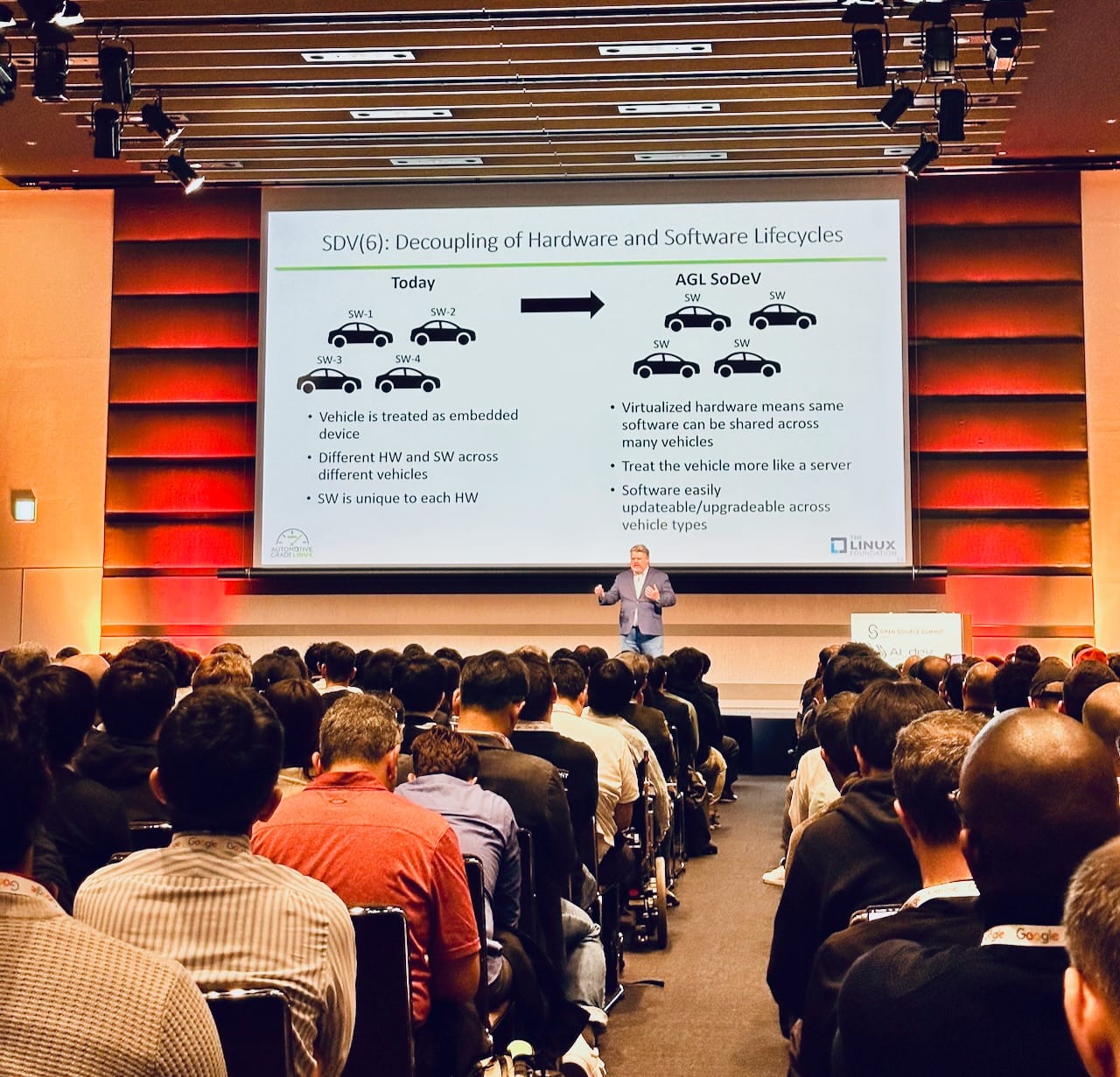
    As Dan Cauchy explained clearly in his opening keynote, and as nearly every session reinforced afterward, a fundamental shift is underway in how vehicles are designed. Historically, cars were built hardware first. The hardware defined the vehicle, and software was written specifically to fit that hardware.

    OSS Japan 2025: A Breakthrough Year for Open Automotive Innovation
    Dan Cauchy opening OSS Japan 2025, setting the stage for software-defined vehicles and open automotive collaboration.

    That model is now being inverted. Software is becoming the defining element of the vehicle experience, while hardware is increasingly abstracted beneath it. This is a familiar pattern. We have already lived through the same transformation in the mobile phone industry, where features are now driven by operating system versions rather than by individual hardware models.

    The automotive industry is following the same path. Software stacks are no longer tightly bound to a single model or trim level. Updates are no longer rare events tied to maintenance cycles. Instead, manufacturers are moving toward unified software platforms that span multiple vehicles, generations, and hardware configurations.

    In the near future, a manufacturer’s software stack will run across a wide range of models and SoCs. The software will define the experience, while hardware diversity is handled through abstraction layers. Throughout the summit, we saw concrete progress toward this vision.

    Renesas showcased the powerful SoCs needed to support mixed criticality workloads. Honda brought these pieces together by showing how open source software stacks can be deployed in real vehicles. Along the way, complementary work from companies like Panasonic on VirtIO and cockpit abstraction illustrated how shared standards enable this ecosystem to scale.

    Honda and Renesas: Leading the Charge Toward Open SDVs

    Two Xen Project board members stood out from the very beginning of the event: Honda and Renesas. Alongside them, other major automotive players, including Ford, are members of the Xen Project, reinforcing that this work is not theoretical but already aligned with real industry adoption. Their talks, booth demos, and architectural choices showed exactly how open source can accelerate automotive innovation.

    Honda: building in house software with open source at the core

    OSS Japan 2025: A Breakthrough Year for Open Automotive Innovation
    Yuichi Kusakabe presenting Honda’s in-house IVI software strategy and open source journey at OSS Japan 2025.

    Yuichi Kusakabe gave several compelling talks describing how Honda grew an in house IVI software team from just two people into a modern organization fully committed to open source. The story was both honest and inspiring. Honda adopted AOSP, embraced SPDX and OpenChain for compliance, built strong internal processes, and delivered production quality IVI software on open foundations.

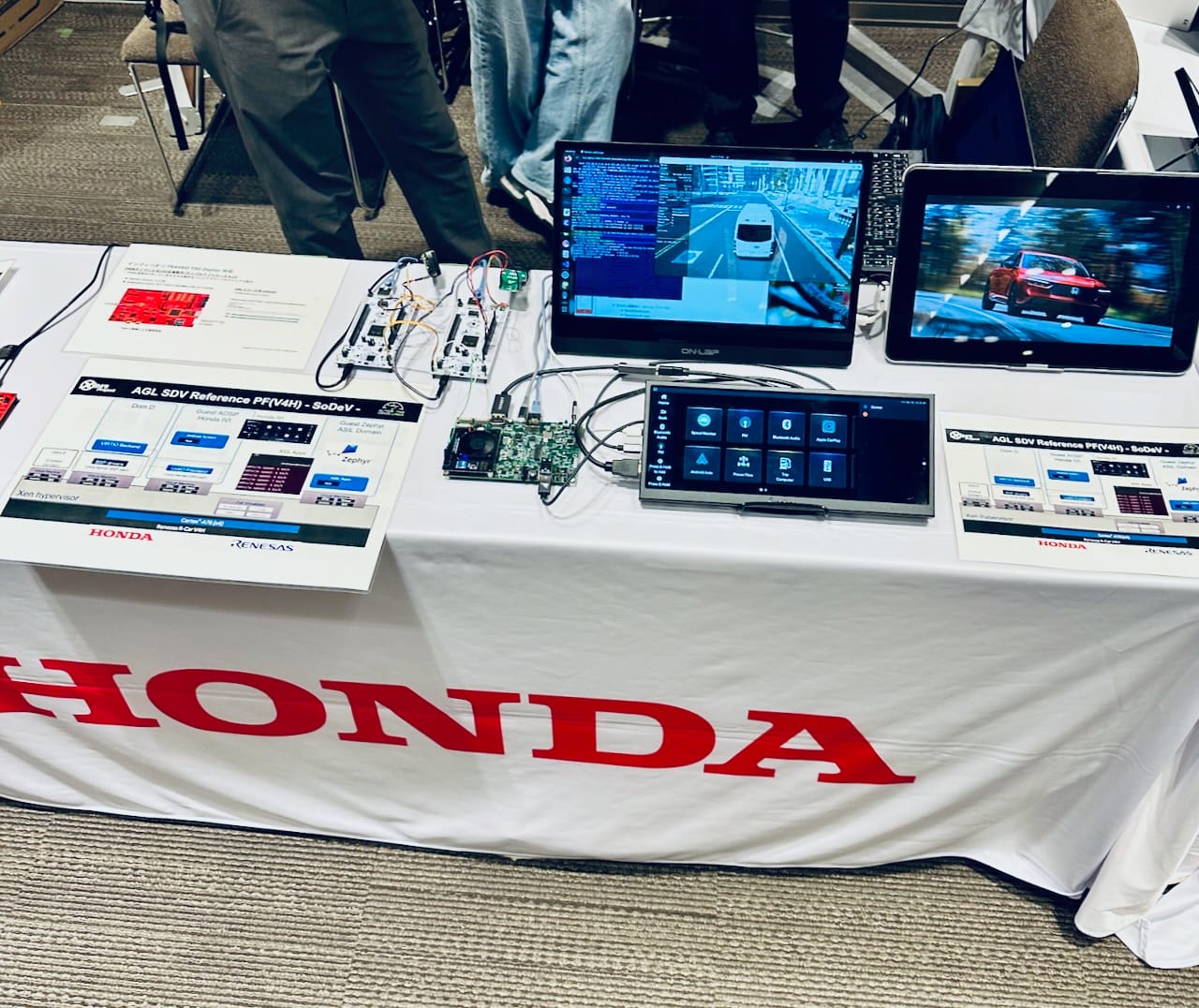
    On the show floor, Honda featured multiple demos running on Renesas hardware with Xen as the hypervisor. These systems followed the AGL reference architecture that appeared in nearly every presentation throughout the event. Seeing real cockpit consoles running on Xen was a powerful confirmation of the direction the industry is taking.

    OSS Japan 2025: A Breakthrough Year for Open Automotive Innovation
    Honda demo hardware running a software-defined vehicle stack on Renesas silicon with Xen as the hypervisor at OSS Japan 2025.

    Renesas: turning SDV concepts into real hardware

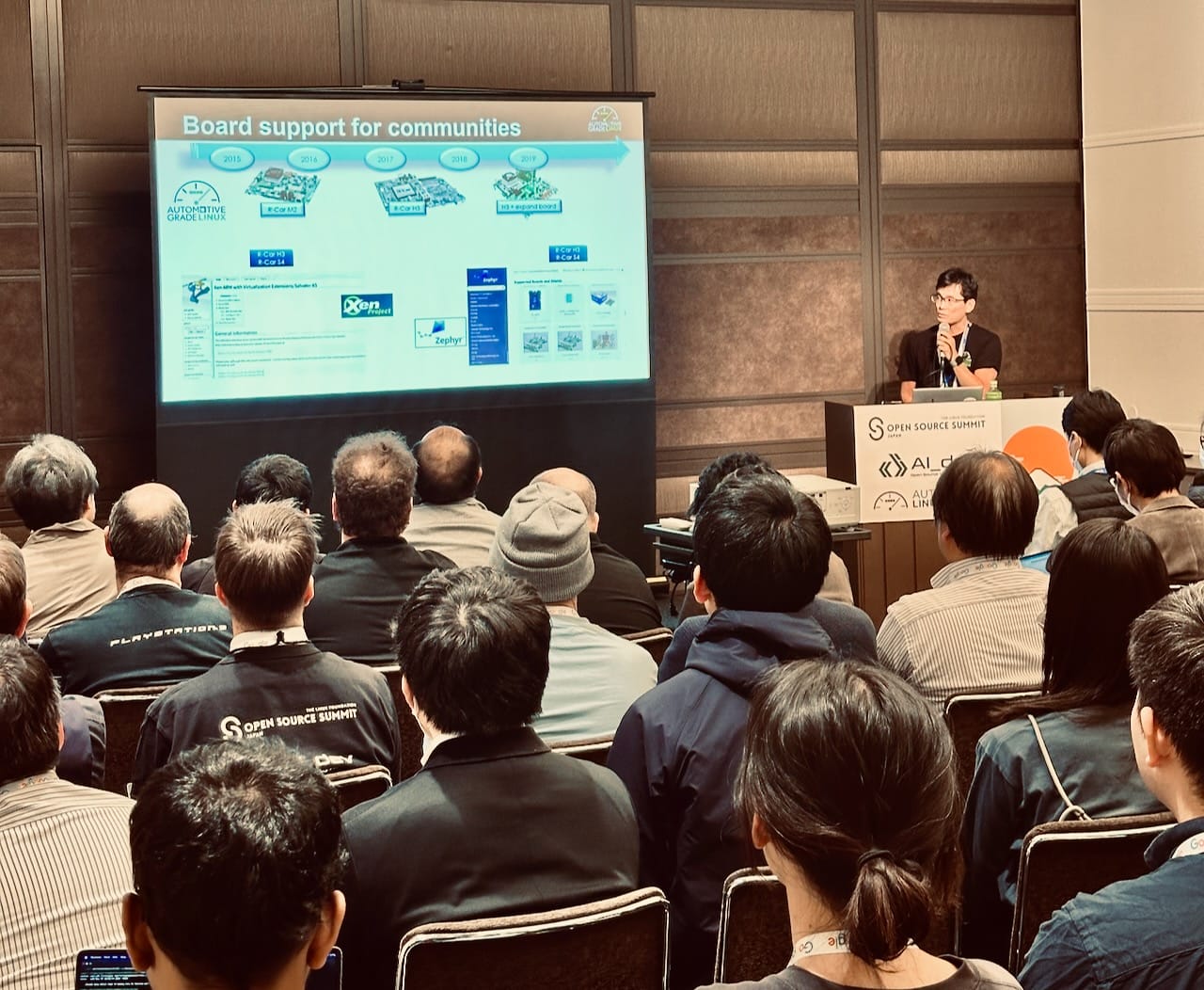
    Renesas delivered one of the strongest technical showings at OSSJ. Their sessions highlighted a unified development environment that bridges Linux, Zephyr, Yocto, and Xen on next generation R-Car SoCs. At their booths, engineers could see real hardware running real mixed criticality workloads side by side, all orchestrated by Xen.

    OSS Japan 2025: A Breakthrough Year for Open Automotive Innovation
    Harunobu Kurokawa presenting Renesas’s open source SDV platform and reference hardware at OSS Japan 2025.

    Renesas also presented a heterogeneous compute platform combining Cortex A76 application cores, Cortex R52 real time cores, and an onboard AI accelerator. This reflects where automotive systems are headed. Workloads are increasingly diverse. Real time constraints coexist with high level applications and AI inference. Xen provides the isolation and flexibility needed to bring these elements together on a single SoC.

    What stood out most was the confidence Renesas showed in demonstrating Xen on safety oriented hardware. Vendors do not make these demonstrations lightly. Renesas is now publicly working toward safety certification for Xen, aligning with the safety milestones discussed in my talk. One year after AMD achieved safety concept approval, Renesas has clearly joined the same path forward.

    Panasonic: advancing VirtIO and cockpit decoupling

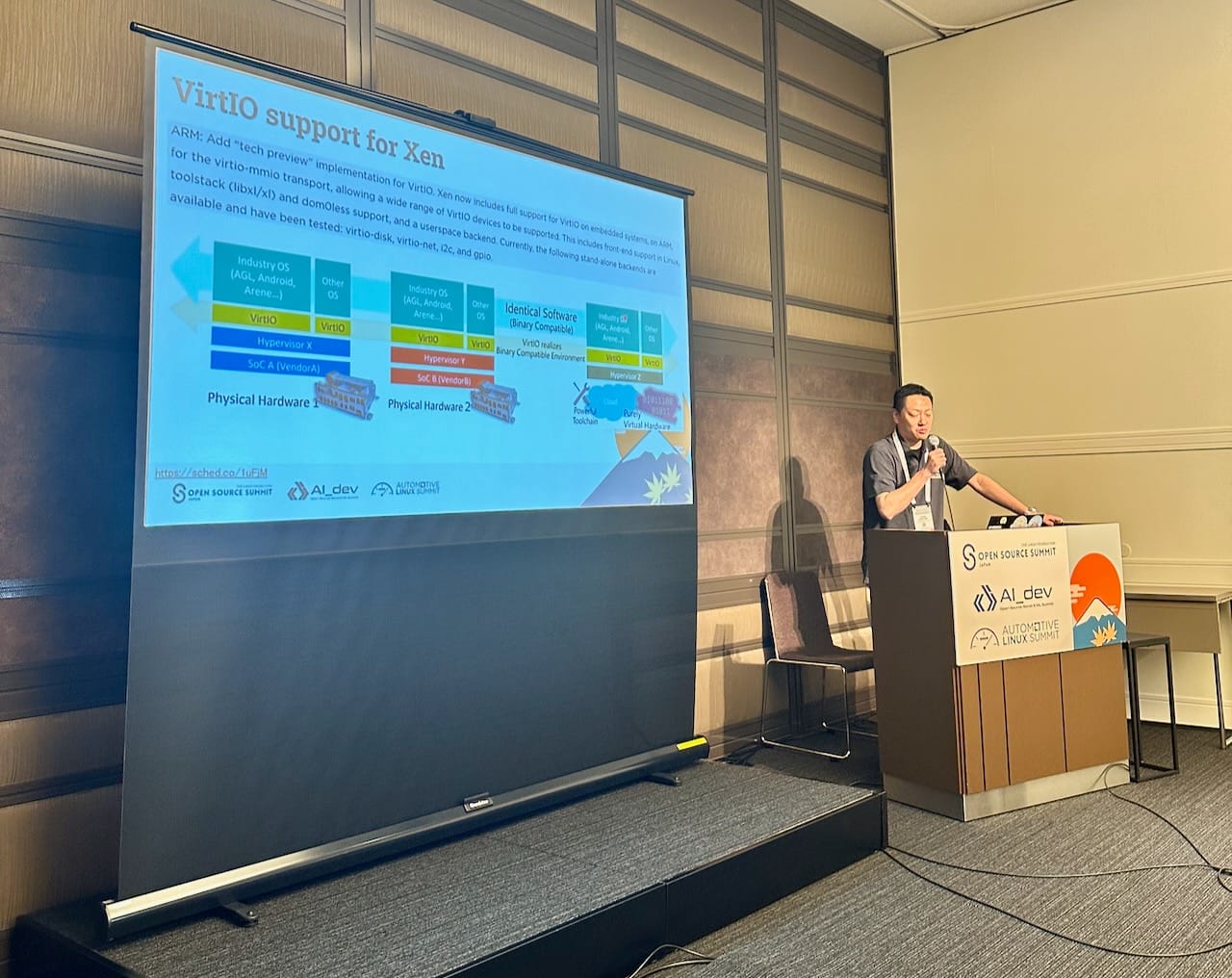
    Panasonic delivered several strong engineering sessions that complemented the broader SDV story at the conference. Their updates from the SDV Expert Group and their work on VirtIO testing highlighted steady progress toward better virtualization quality and interoperability.

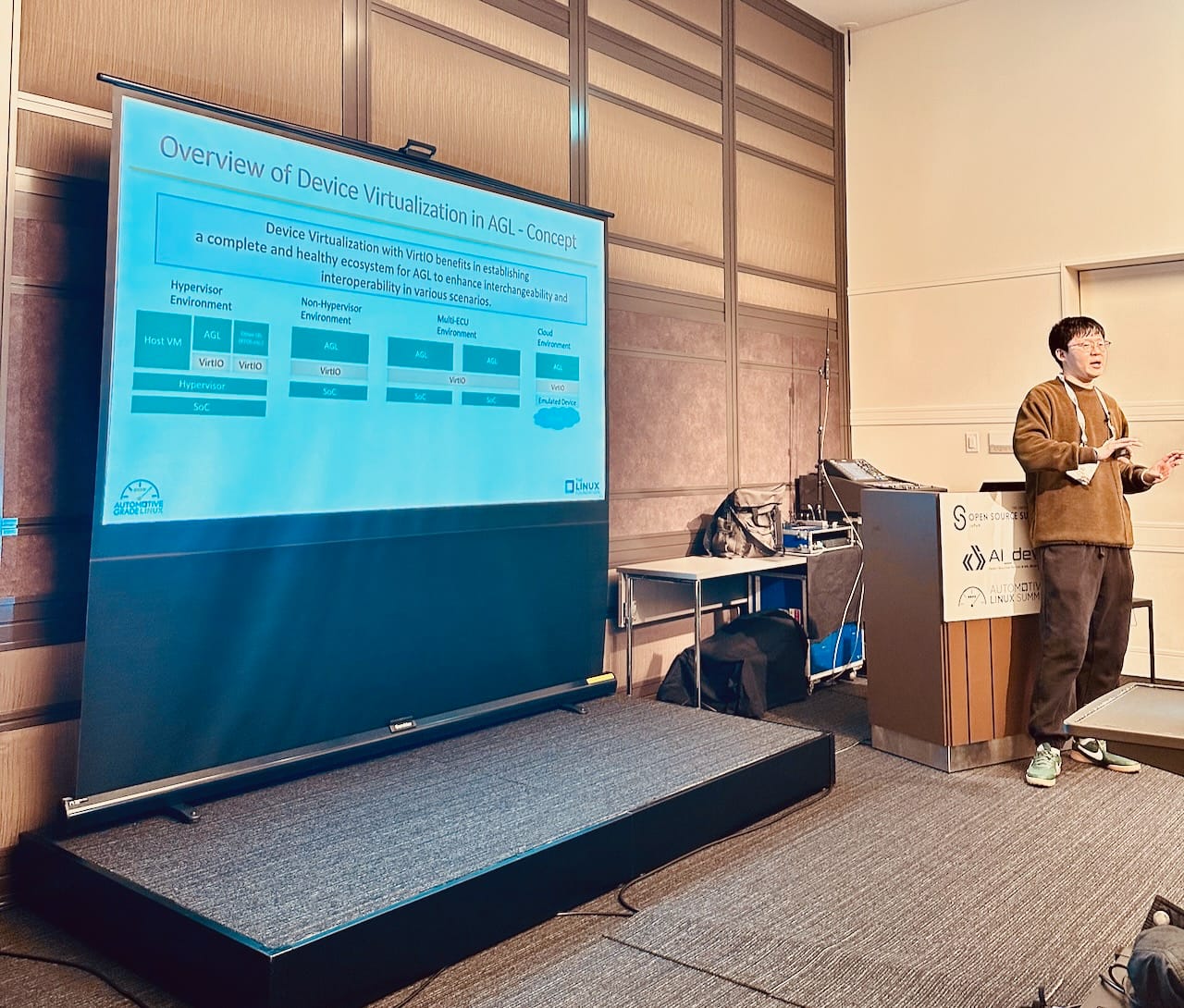
    OSS Japan 2025: A Breakthrough Year for Open Automotive Innovation
    Jerry Zhao presenting Panasonic’s work on VirtIO as part of the AGL Software Defined Vehicle architecture at OSS Japan 2025.

    The Unified HMI v2.0 presentation was a good illustration of where cockpit architectures are heading. By decoupling displays from the applications that render them, and by supporting multiple writers and multiple screens across AGL and Android, Panasonic showed how virtualization can simplify complex UI pipelines.

    While Panasonic is not currently a Xen Project member, their work clearly contributes to the wider ecosystem that many of our members are building upon. These efforts reinforce the importance of open interfaces and shared standards in modern automotive stacks, and they align naturally with Xen-based SDV architectures.

    A Shared Architecture Emerges: AGL SoDeV Takes Center Stage

    One of Xen’s unique strengths is that the same core hypervisor technology is used across embedded, automotive, and server environments. Members such as Citrix (XenServer) and Vates build Xen-based solutions for large-scale server and cloud deployments, while automotive members apply Xen to safety critical and embedded systems. This shared foundation allows improvements in security, performance, and tooling to benefit all deployment models.

    At the heart of nearly every SDV discussion was the same core stack: AGL on top of Linux, Xen providing isolation and virtualization, and Zephyr acting as the real time operating system for safety and control oriented workloads. This combination appeared consistently across talks, demos, and reference diagrams.

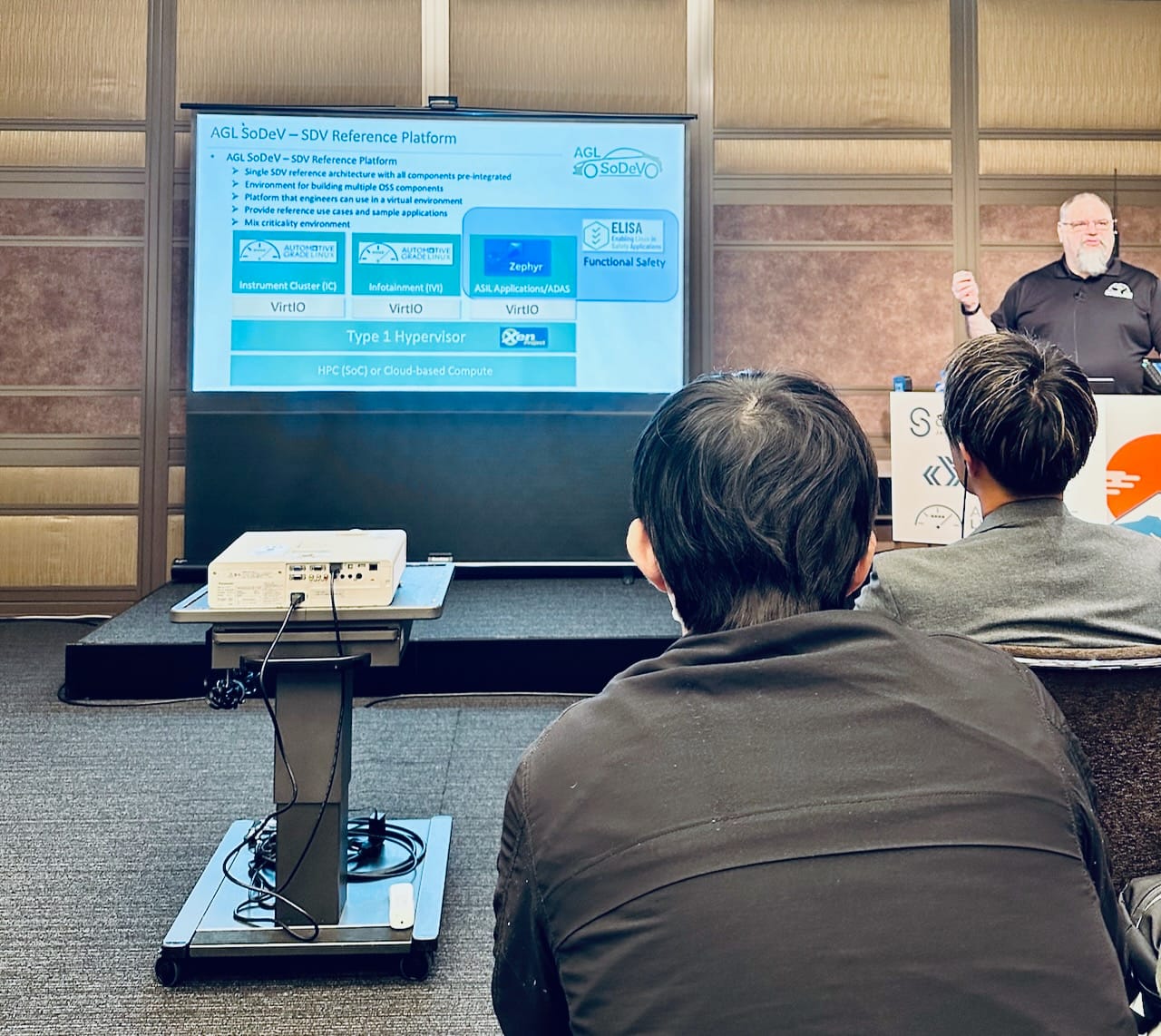
    One theme appeared again and again throughout the summit. Nearly every presentation included the same AGL Software Defined Vehicle architecture diagram. At its core were VirtIO, Yocto, Zephyr, and Xen as the hypervisor.

    OSS Japan 2025: A Breakthrough Year for Open Automotive Innovation
    Walt Miner presenting the AGL Software Defined Vehicle reference architecture at OSS Japan 2025.
    🧩
    A clear pattern emerged at OSSJ
    Across vendors and presentations, the same SDV stack kept appearing: AGL, Xen, Zephyr, VirtIO, and Yocto. This level of alignment is a strong sign that the industry is converging on shared, open foundations.

    This level of alignment across vendors is a strong sign of maturity. When engineers agree on foundational building blocks, innovation accelerates. For SDVs, mixed criticality workloads are unavoidable. Infotainment, telematics, OTA services, sensor processing, and safety functions must coexist on the same SoC. This demands strong isolation and predictable performance, both of which Xen provides. Alongside Xen, Zephyr has clearly emerged as the go to real time operating system within this architecture, with a roadmap toward safety certification and growing adoption across automotive platforms.

    Some OEMs, including Toyota, still rely heavily on QNX today. I had several thoughtful conversations with Toyota engineers who were curious about open alternatives. When organizations look for openness, strong performance, and a roadmap they can influence, Xen becomes increasingly attractive. While some benchmark data remains private, it is clear that modern open source hypervisors can match or exceed proprietary solutions in critical areas.

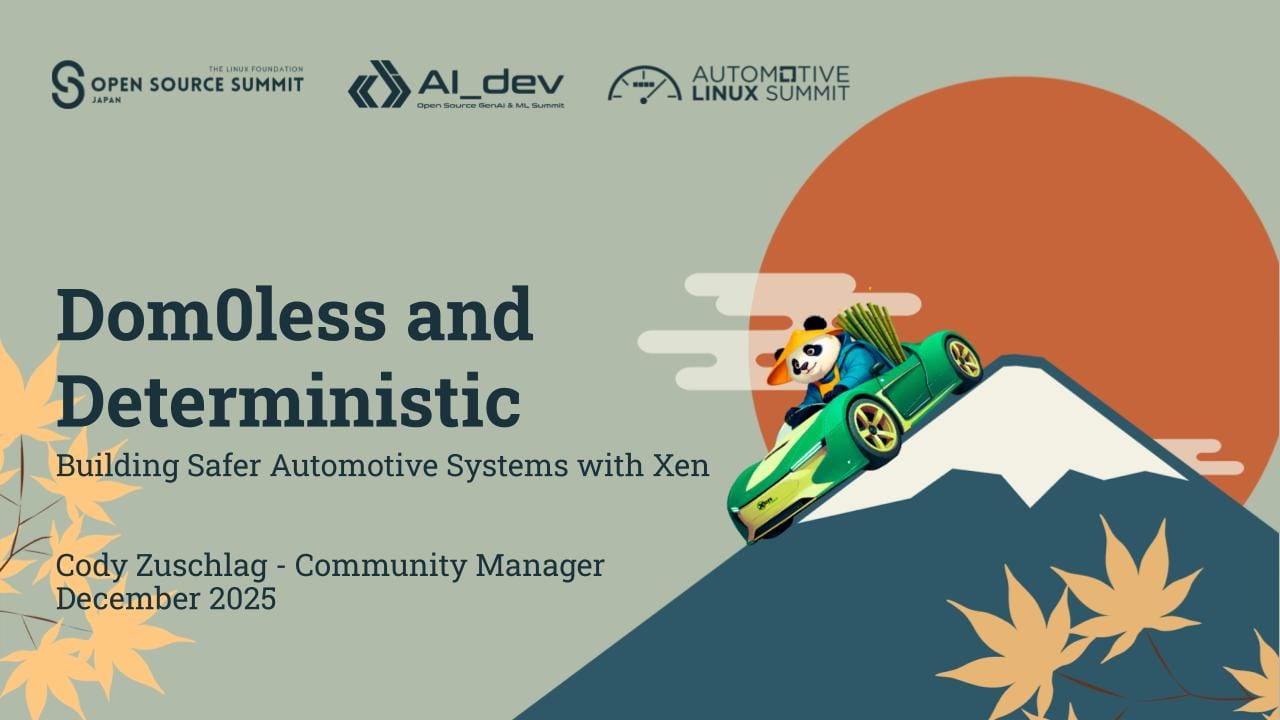
    My Talk: Dom0less Xen for Deterministic Automotive Systems

    An important part of this discussion is how Xen and Zephyr work together in practice.

    I was glad to share how Xen can be configured in dom0less mode for embedded automotive use cases. The audience was highly engaged, particularly around deterministic startup behavior and the benefits of a smaller trusted computing base.

    📽️
    If you’d like to dive deeper, the slides from this talk are available here: Dom0less and Deterministic: Building Safer Automotive Systems with Xen (PDF)

    A recording of this session, along with other OSS Japan talks, will be added once they are published.

    The presentation covered how Xen can run in dom0less mode, and how Zephyr fits naturally into this model as a lightweight, deterministic operating system:

    • Predictable, parallel domain boot
    • Bounded interrupt latency
    • Clear isolation for safety critical systems
    • A Raspberry Pi 5 proof of concept running Zephyr and Linux in multiple domains
    • Early and natural alignment with the AGL SDV architecture
    ⚙️
    Xen and Zephyr are better together
    Xen provides strong isolation and determinism, while Zephyr delivers a lightweight, real-time OS with a clear path toward safety certification. Together, they form a practical foundation for mixed-criticality automotive systems.

    These concepts illustrated how dom0less Xen supports reproducible, deterministic system behavior that maps well to automotive safety requirements. Zephyr makes an excellent fit for a very lightweight dom0 when needed, or for tightly scoped system domains that handle specific responsibilities during normal vehicle operation, such as diagnostics, monitoring, or controlled domain creation. After the session, several engineers reached out to discuss using dom0less Xen for cockpit systems, ECUs, robotics platforms, and industrial controllers. The level of interest was higher than I expected.

    Xen 4.21: Modernization and Security for the Next Generation

    These architectural advances are supported by strong upstream progress in Xen itself.

    We also celebrated the release of Xen 4.21 in November 2025. This release represents a major step forward in modernization and security hardening.

    Key improvements include:

    • Arm security hardening and improved determinism
    • More predictable interrupt latency
    • Memory management refinements
    • Broader CI coverage on Arm and x86
    • Continued modernization of the codebase
    • Early support for RISC V

    These improvements strengthen Xen for real time and safety aligned workloads. As SDVs scale across architectures, having a hypervisor that works naturally on Arm, x86, and emerging RISC V platforms is a significant advantage. This flexibility is essential for OEMs building long lived platforms that must evolve over many years.

    OSS Japan 2025: A Breakthrough Year for Open Automotive Innovation
    Outside the Open Source Summit Japan 2025 venue in Tokyo.

    Safety Certification: a Community Driven Path Forward

    Safety is the next major frontier for open hypervisors, and Xen is making steady progress.

    • AMD achieved safety concept approval in 2024
    • Renesas is actively working toward safety certification in 2025
    • The Xen Project is building a community driven pilot for Safety Certification Ready

    This work includes open safety artifacts, clear documentation, public CI, and reproducible system behavior. Zephyr follows a similar path, making the Xen and Zephyr combination particularly compelling for safety oriented SDV designs. As companies see a visible and transparent path toward certification, the case for using open source in safety critical environments becomes much stronger.

    🛡️
    Safety work is already underway
    With AMD achieving safety concept approval and Renesas publicly working toward certification, the Xen community is building a transparent, collaborative path toward safety-ready open systems.

    Why Automotive Companies Are Turning to Xen

    This shift toward SDVs also enables another critical capability: over the air updates.

    By the end of the week, the message was clear:

    • Xen is already part of the AGL reference architecture
    • Major vendors deploy Xen on real automotive hardware
    • Performance is competitive with proprietary hypervisors
    • Xen offers transparency, flexibility, and no licensing fees
    • Companies can directly influence the roadmap through contributions
    • The safety story continues to strengthen

    This combination of openness, performance, and industry alignment is exactly what engineers and decision makers are looking for. SDV architectures built on Xen, Zephyr, and AGL make it possible to deliver frequent OTA updates that improve functionality, fix issues, and strengthen security over the lifetime of a vehicle. This is a dramatic change from the once per year, or less, update cycles that drivers are used to today.

    🔄
    From yearly updates to continuous improvement
    Software-defined vehicles make frequent OTA updates possible. This unlocks new features, improves security, and extends vehicle lifetimes far beyond the traditional once-per-year update cycle.
    OSS Japan 2025: A Breakthrough Year for Open Automotive Innovation
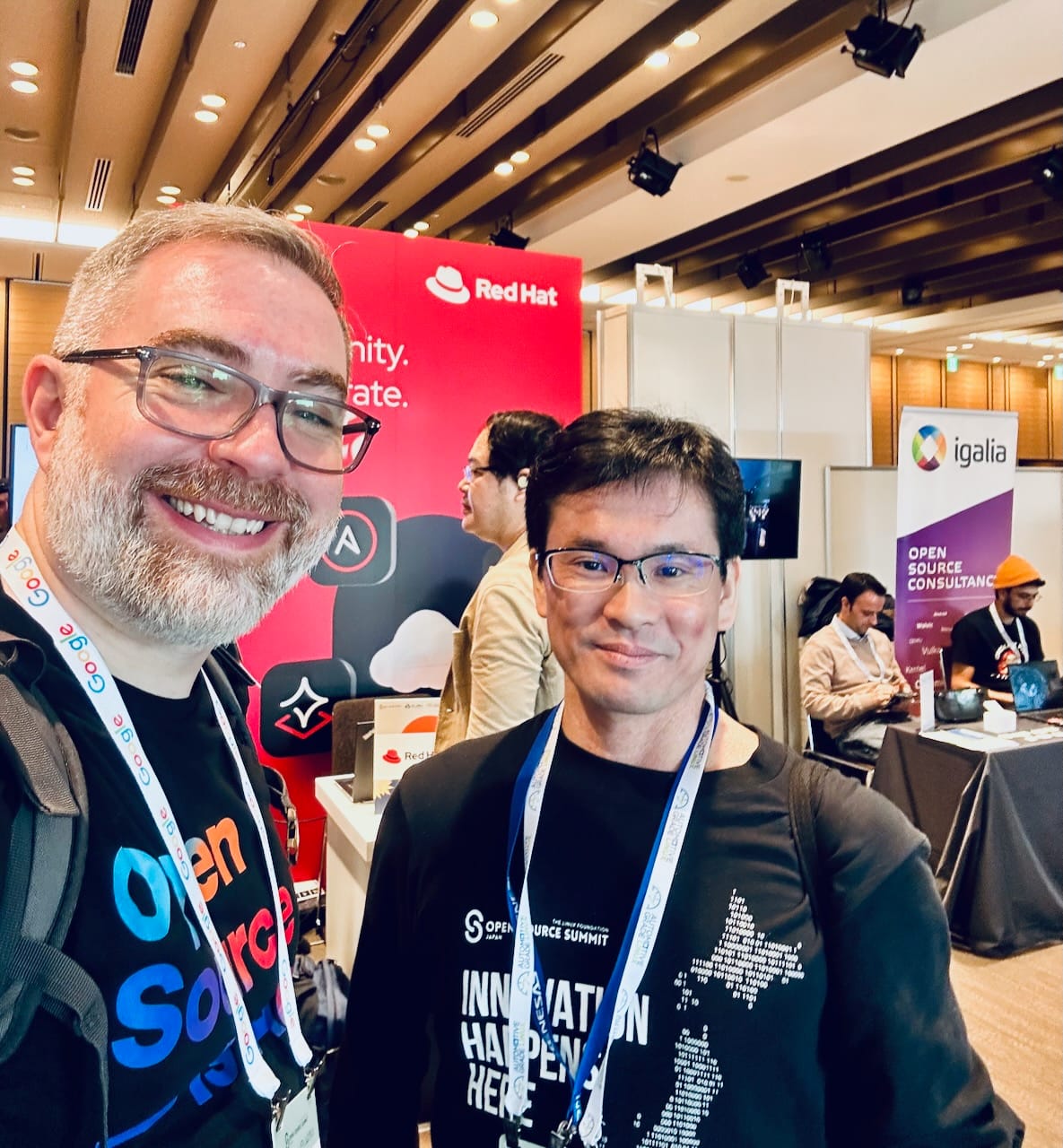
    Harunobu Kurokawa (Renesas) and Cody Zuschlag (Xen Project) at OSS Japan 2025.

    Closing Thoughts and an Invitation

    It would also be incomplete not to acknowledge the work of EPAM, another Xen Project member. While not physically present at the conference, EPAM’s engineering contributions were very much visible behind the scenes.

    I left OSS Japan feeling proud of the Xen community and grateful for the leadership shown by Honda, Renesas, Panasonic, and many others shaping the future of automotive software. The demos were impressive, the hallway conversations were energizing, and the collaboration across projects felt stronger than ever. My own Raspberry Pi demo was built directly on EPAM’s ongoing work to create real world SDV architectures across multiple platforms, and it is a great example of how member contributions extend far beyond the show floor.

    If your organization is exploring software defined vehicles, virtualization, or open automotive platforms, now is an excellent time to get involved. The Xen Project community is open, supportive, and excited to collaborate.

    🤝
    Join the conversation
    If your organization is exploring software-defined vehicles, virtualization, or open automotive platforms, the Xen Project community is open, collaborative, and ready to work together.

    Feel free to reach out, and stay tuned as our safety work continues to move forward.

  • 🛠️ Engineering Trust: How Xen’s Open CI Powers Global, Hardware-Level Testing 10 July

    🛠️ Engineering Trust: How Xen’s Open CI Powers Global, Hardware-Level Testing

    In safety-critical industries like automotive and industrial systems, trust is non-negotiable. When building software that controls critical hardware, like braking systems or factory automation, you need confidence. The software must behave exactly as intended. Every time. On the actual device.

    That's why the Xen Project is investing in a new kind of continuous integration (CI). A CI that is open, transparent, and global.

    🧠
    The Xen Project is hosted by the Linux Foundation, ensuring the project remains open, protected, and community-governed.

    This lets adopters of one of the world’s most secure and stable open-source hypervisors, Xen, have confidence in the software that controls their hardware. Xen is laying the foundation for the next generation of automotive and industrial systems. Systems that demand high core counts per watt and per square centimeter.

    🚀 A CI Pipeline That Meets You Where You Are

    Most open source CI pipelines run on generic cloud VMs. These are great for catching bugs and enforcing code quality. But they rarely replicate real-world hardware conditions.

    That doesn’t cut it when you're working with diverse hardware architectures or building for mission-critical deployments.

    Xen’s CI is different.

    It supports real bare-metal testing across a globally distributed fleet of devices.

    Contributors can see, in real time, how their changes perform on:

    • Arm boards
    • x86 servers
    • Embedded platforms
    • ...and more

    And this is only the beginning.

    🔧 Bring Your Own Hardware

    Partners can contribute their own on-site test hardware, like embedded boards, laptops, and servers, to the CI network. All by following some straightforward setup guidelines. This allows consumers and integrators to run the Xen test jobs and confirm that Xen runs correctly on their specific devices. In this way, everyone benefits form the larger Xen Project infrastructure.

    🔐
    This means companies working with proprietary or pre-release silicon can test changes securely, behind their own firewall, while still benefiting from community collaboration.

    With modern System-on-a-Chip (SoC) designs, development cycles require fast validation across the full software stack, hypervisor included.

    🚗 Why This Matters for Automotive and Embedded Innovators

    Companies like Honda, Ford, Renesas, Arm, and AMD are already on the Xen Project Advisory Board. They know that long-term success in embedded systems depends on more than just good code. It requires a transparent, reproducible, and community-driven process.

    Xen’s CI delivers:

    • Hardware Assurance: Real testing on real devices, not just emulated environments.
    • 🌍 Customization Without Isolation: Add test devices on-site, without giving up collaboration.
    • 🧾 Traceability: Every test is logged, traceable, and publicly viewable.
    • 📊 Global Visibility: A live CI status page shows what’s running, where, and how it’s performing.
    • ⏱️ Faster than the Lab: Say goodbye to the cost and delay of external test labs. CI results happen in minutes, not days.

    👉
    Learn more on our CI overview page

    🤝 A Model for Open Collaboration

    This isn’t just a CI. It's a model for how open source communities and industry can work together.

    By opening our infrastructure and inviting partners to participate directly in validation, we’re proving that shared tooling can meet enterprise requirements. All without compromising security or intellectual property.

    We believe this approach is the future of safety-critical open source.

    🧭 Join the Mission

    Are you working on hardware that could benefit from secure, stable, and scalable virtualization?

    🎯
    Join us as a voting member of the Xen Project Advisory Board. Help shape the direction of Xen and power the next wave of innovation in embedded systems.

    We’re building something different.
    Something open.
    Something real.


    Learn more about the Xen CI

  • 🛠️ Xen Summit 2025: Find Your Place in the Future of Virtualization 27 June

    🛠️ Xen Summit 2025: Find Your Place in the Future of Virtualization

    The annual Xen Summit is right around the corner, and there has never been a more exciting time to be part of the Xen Project.

    As enterprise and industrial needs shift and proprietary vendors rethink their licensing, the industry is ready for strong, open alternatives. Xen stands out not only as a reliable solution, but as a versatile, battle-tested, and community-driven hypervisor that’s ready to meet the computing needs of the future.

    Whether you’re building for the cloud, the car, or the next wave of secure computing, Xen is like a Swiss army knife for virtualization: a trusted, adaptable tool powering real innovation across many industries.

    🔄 One Hypervisor, So Many Uses

    Xen isn’t just growing in one area. It’s powering innovation across four major domains:

    • 🚗 Automotive and Safety-Critical Systems From software-defined vehicles to secure ECUs, Xen allows carmakers to consolidate hardware, reduce cost, and increase system isolation. It’s a natural fit for safety-first design.
    • 🏭 Industrial and Embedded Use Cases In rugged, real-time, and space-constrained environments, Xen offers low-overhead virtualization that is efficient, stable, and scalable.
    • 🖥️ Enterprise Servers and Cloud Data Centers Xen is built for high performance at scale. It helps multi-core systems deliver more compute per kilowatt and per square meter—critical in today’s data center environments. XCP-ng, a subproject of the Xen Project, is a drop-in replacement for that pesky and expensive proprietary virtualization platform.
    • 🧑‍💻 End-User Virtualization and Desktop Security Xen is the foundation of security-focused systems like Qubes OS, where each app runs in its own virtual machine. It plays a key role in building compartmentalized, secure desktop environments.

    These are not just ideas or future goals. They’re active, real-world use cases where Xen is already making a difference.

    🗓️ What to Expect at Xen Summit

    Hosted at AMD’s (formerly Xilinx) San Jose campus, Xen Summit 2025 is the premier gathering for the Xen community. It brings together project contributors, Advisory Board members, and implementers from across the ecosystem. Whether you’re a seasoned developer or a curious newcomer, this is the place to connect.

    🌅 Mornings: Presentations and Announcements

    Each day kicks off with a lineup of talks, demos, and lightning presentations that showcase the latest developments across the Xen ecosystem. Expect exciting updates, real-world success stories, and a clear look at where Xen is heading next.

    🧠 Afternoons: Interactive Design Sessions

    The afternoon sessions give the community a chance to dive into key topics through an open, collaborative format. Attendees vote on the subjects they want to explore, and the most popular ones are discussed in town hall–style sessions. Everyone is welcome to ask questions, share ideas, and help shape Xen’s future.

    🤝 Backed by Industry Leaders

    This year’s summit is proudly supported by sponsors including AMD, ARM, Honda, XenServer, and Vates, with more to be announced soon. Their support reflects the growing momentum behind Xen and a shared commitment to building open, secure, and high-performance virtualization together.

    📣 CFP Still Open… We Want to Hear From You 🫵

    Have something to share? We’d love to see your proposal.

    🚨
    The Call for Proposals is open until July 1. Whether you’re solving problems with Xen, building something new, or have insights to share, this is your opportunity to be part of the program.

    👉 Submit your talk here

    👥 A Community-Powered Future

    Xen continues to grow as the world’s most secure, performant, and open hypervisor because of the people behind it. The summit is more than just an event. It’s the premier opportunity to connect, collaborate, and shape the future of virtualization together.

    The Xen Project is proudly hosted by the Linux Foundation, helping ensure stable, neutral governance and a sustainable future for the project.

    Whether you’re optimizing cloud workloads, securing embedded systems, or building safety-critical platforms, now is the perfect time to get involved—or get even more involved—with Xen.


    🔗 Join us this September

    Learn more and register: https://xenproject.org/resources/xen-summit

    Let’s build the future of virtualization, together.

  • Let’s Grow Xen Together! 18 March

    Hey everyone,

    I’m excited to step-up to the role of Community Manager for the Xen Project! For those that I haven’t met yet, I’m Cody Zuschlag. My focus is on growing and strengthening the Xen community: expanding our contributors, welcoming new members, and ensuring a thriving, collaborative ecosystem. The Xen project has been supported by some incredible community managers in the past and while their shoes won't be easy to fill, I'm ready to take on the challenge!

    Why Xen?

    First, let's talk about why I love Xen. Xen is open source, security-first, and built for the future. It has powered critical infrastructure for decades, and today, its role is more important than ever:

    • Modern Data Centers & AI: With the rapid expansion of AI and cloud workloads, Xen provides a secure, scalable, and efficient foundation for virtualization.
    • Embedded Systems & Edge Computing: Xen’s strong isolation and stability make it the ideal choice for automotive, industrial IoT, and other mission-critical applications.
    • A Cost-Effective, Open Virtualization Solution: As proprietary virtualization platforms introduce higher costs, more restrictions, and unexpected licensing changes, organizations are looking for flexible, open solutions. Xen-based technologies provide a mature, high-performance alternative that puts businesses in control. All without vendor lock-in.

    And the future? It's looking very bright... There are some incredible innovations on the way that will be powered by Xen, shaping the next generation of virtualization.

    Building an Even Stronger, More Open Community

    My biggest goal is to expand the contributor community. That means making sure everyone feels welcome to get involved.

    Open source thrives when people with different skills and backgrounds come together. And the best part? You don’t have to be a developer to make an impact.

    👐
    Whether you’re contributing code, documentation, testing, security expertise, research, or community support, there’s a place for you in Xen.

    What I’ll Be Focusing On

    • Bringing in new contributors: Lowering barriers to entry and making it easier for people to get involved.
    • Expanding Xen’s membership: Growing the list of organizations and individuals helping to drive the project forward. By working together to create the best foundation, everyone benefits.
    • Creating an open and welcoming environment: A strong community is one where people feel supported, valued, and encouraged to participate.
    • Supporting Xen’s development: Helping maintainers, developers, and contributors work more efficiently and effectively.
    • Advocating for Xen as the best virtualization technology: Because it is! Xen’s security-first design, maturity, and flexibility make it the top choice for modern virtualization.

    Let’s Shape the Future of Xen Together

    The Xen Project has a long history of innovation, but its best days are still ahead. Whether you’ve been involved for years or are just discovering Xen, I’d love to hear from you!

    What’s working? What could be better? How can we make Xen even more accessible and impactful?

    Connect with me on Matrix, send me an email at community.manager@xenproject.org, or connect on LinkedIn.

    Looking forward to working with all of you!

    Cody

  • Xen Project 4.20: A Step Forward in Open Source Virtualization 11 March

    The Xen Project has released Xen 4.20 🎉! This release introduces a range of enhancements that further solidify its position as the premier open-source hypervisor. It delivers important security updates, improved performance, and broader hardware support. Xen has doubled down as the best choice for cloud providers, enterprise users, and embedded system developers.

    💡
    Why Xen?
    With strong security, high performance, and cross-architecture support, Xen remains the go-to choice for cloud providers, enterprise users, and embedded system developers.


    Read the official Xen Project 4.20 Press Release from the Linux Foundation.

    Evolution of Xen 4.20: The Big Picture

    Xen 4.20 is not just a routine update. Instead, it reinforces Xen's clear vision of the future of virtualization. The changes in this release can be grouped into three basic themes. Each theme underscores the Xen Project's continued growth and relevance in modern computing:


    1. Security is the Foundation

    Security has always been the key priority of Xen. Version 4.20 yet again demonstrates how Xen's security stance distinguishes it far above the classic and emerging alternatives. Changes include expanding MISRA C compliance, integrating fuzzing techniques, and enabling UBSAN by default. These changes strengthen Xen's ability to prevent vulnerabilities at the source.

    🔐
    Security First:
    Xen 4.20 reinforces its proactive approach to security by integrating advanced fuzz testing, enforcing MISRA C compliance, and enabling UBSAN by default.


    This is yet another example of why open source is the best approach to security-focused development. These security enhancements demonstrate the project's commitment to proactive threat mitigation. Xen remains the trusted solution for enterprise and cloud environments where isolation and reliability are crucial.


    2. Performance and Optimization for Modern Workloads

    Modern workloads place increasing demands on computing resources. As a result, virtualization platforms must continuously evolve to meet these needs. Xen 4.20 introduces performance optimizations in some key areas. These include guest page-table management, cache utilization, and device passthrough. Paging-Write support on Intel CPUs and AMD Zen 5 optimizations ensure Xen remains competitive with proprietary hypervisors. Improvements to Xen's hypervisor architecture balance raw performance with system robustness.

    Performance Meets Stability:
    Xen 4.20 enhances both speed and robustness, making it the ideal hypervisor for everything from large-scale cloud deployments to resource-constrained embedded systems.


    This magic combination makes Xen the high performance choice in every situation from cloud-scale deployments to embedded applications.


    3. Expanding the Architectural Footprint

    An exciting step towards the future with Xen 4.20 is its expansion to architectures beyond x86 and Arm. The release includes foundational improvements in RISC-V and PowerPC, indicating early-stage development in these architectures. It's important to note that while these architectures are not yet fully supported, this release introduces key improvements in the boot process and memory management. These improvements pave the way for broader support in future releases.

    💡
    A Future-Ready Hypervisor:
    As industry trends shift toward alternative architectures like RISC-V and Arm, Xen is evolving to meet tomorrow’s computing demands today.


    Industry trends are shifting toward alternative processor architectures, and Xen is keeping pace. Experimental ARMv8-R and added compatibility for the NXP S32G3 processor family demonstrate Xen's ambition to be a truly multi-platform hypervisor. Xen is capable of running on a wide range of hardware configurations. As computing environments continue to diversify, Xen is positioning itself as a versatile solution. While RISC-V is gaining traction as an emerging architecture, PowerPC improvements remain focused on legacy support.

    Xen 4.20 Key Highlights

    Building on the above categories, this release introduces multiple technical enhancements in security, performance, and architecture. Here's a short list:

    Security & Code Quality Enhancements

    • Expanded MISRA C compliance: The integration of the ECLAIR MISRA C scanner in GitLab CI now enforces 90 rules with zero unjustified violations, strengthening Xen’s code safety.
    • UBSAN (Undefined Behavior Sanitizer) enabled by default in the CI for x86, Arm64, RISC-V, and PowerPC.
    • Two existing fuzzing harnesses integrated into OSSFuzz to proactively identify and mitigate potential vulnerabilities.

    Core Hypervisor Improvements

    • Fixes in the blkif protocol specification for non-512b sector sizes.
    • The domain builder in libxenguest now defers un-gzipping secondary modules to the guest kernel, optimizing memory and performance.
    • Enhancements to bit-operation helpers and improvements in Xen’s common/arch code split for better maintainability.

    Expanded Architecture Support


    x86 Enhancements

    • Intel Paging-Write Feature support, improving guest page-table update efficiency and reducing EPT violation overhead.
    • AMD Zen 5 CPU support, including mitigations for the SRSO speculative vulnerability.
    • UEFI firmware boot improvements, avoiding problematic GetTime() and ResetSystem() runtime methods to enhance compatibility.
    • Deprecated support for Xeon Phi processors and x2APIC Cluster Mode.


    Arm Enhancements

    • Last Level Cache (LLC) coloring for better performance optimization.
    • Experimental Armv8-R support and support for the NXP S32G3 processor family.
    • FF-A improvements: Indirect message support and enhanced buffer transmission.
    • Xen moves closer to functional safety certification with 43 new structured requirements, using OpenFastTrace for requirement linking.


    Early-Stage RISC-V and PowerPC Development

    • RISC-V: Initial enhancements in device tree mapping and memory management initialization.
    • PowerPC: Early improvements in boot allocation.

    Security Fixes and Industry Support

    During the 4.20 development cycle, eight Xen Security Advisories (XSAs) were published. Four fixes in the hypervisor, one fix in the toolstack, one clarification on supported use cases, and two fixes in external projects.

    This release was made possible with contributions from major industry players including AWS, ARM, AMD, HONDA, EPAM, Vates, and XenServer. This collaboration demonstrates that Xen continues to evolve as the trusted solution in cloud computing, security applications, and embedded systems.

    The Growth and Future of Xen

    The Xen Project has come a long way since its origin in academia. It has evolved into a powerful and adaptable hypervisor used in enterprise, cloud, and embedded systems. Xen's continued focus on security, performance, and cross-architecture support demonstrates a clear reality: the project remains relevant in an ever-changing technology landscape.

    Industry leaders are backing and contributing at increased levels. Use cases for Xen are expanding. Xen is on a clear trajectory toward functional safety certification. The future of Xen is brighter than ever. Now with support for emerging architectures like RISC-V and enhanced ARM integration. Xen is poised to be the best option for next-generation computing environments.

    As organizations prioritize security, performance, and flexibility in virtualization, open-source solutions are becoming the standard. With its latest advancements, Xen remains the clear leader in this space. The Xen 4.20 release doubles down on Xen's commitment to innovation.

    🚀 Join the Community!

    Xen 4.20 is just the beginning. We invite developers, enterprises, and cloud providers to contribute, collaborate, and push open-source virtualization forward.

    👉 Get Involved Here

  • Xen Project Winter Meetup 13 February

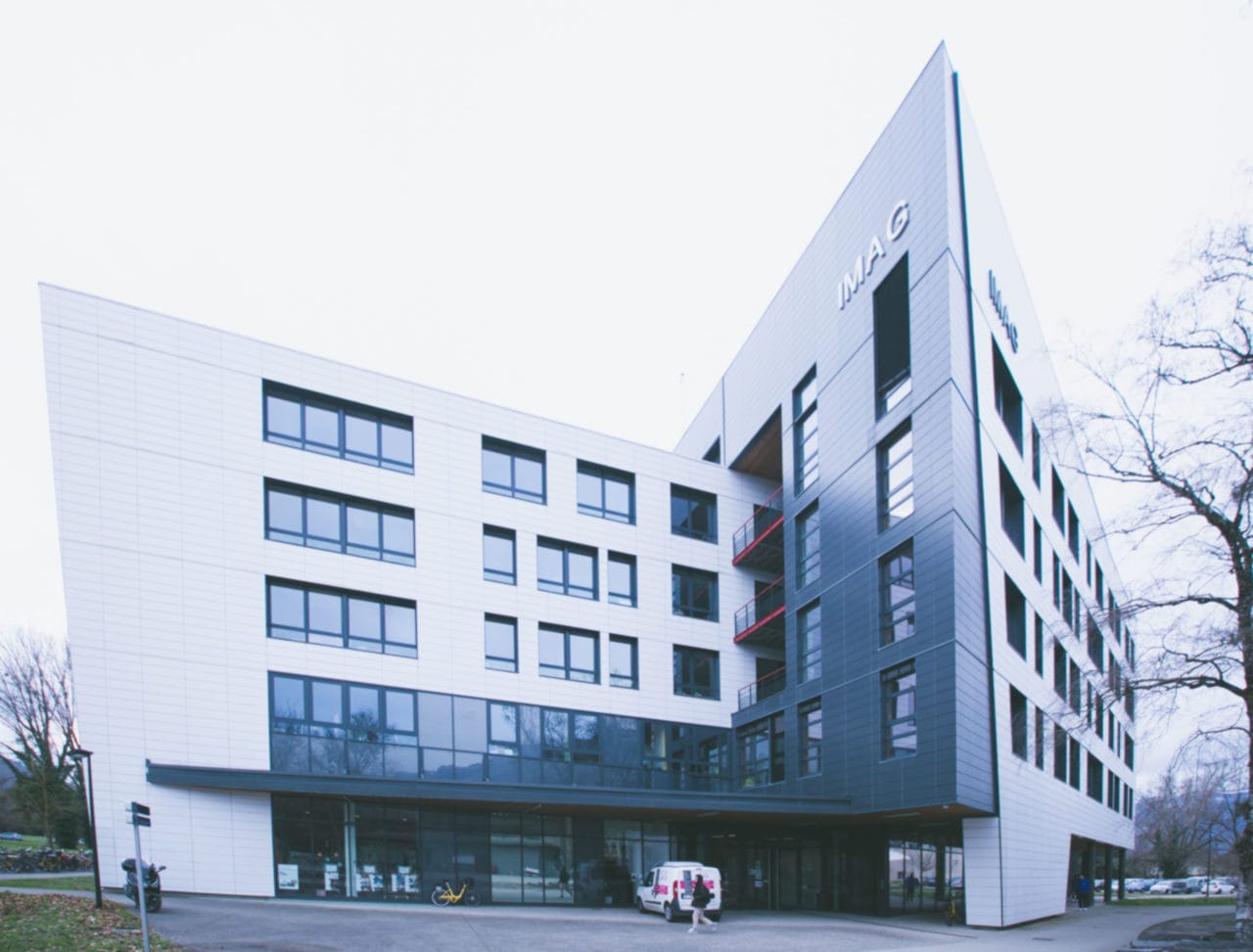
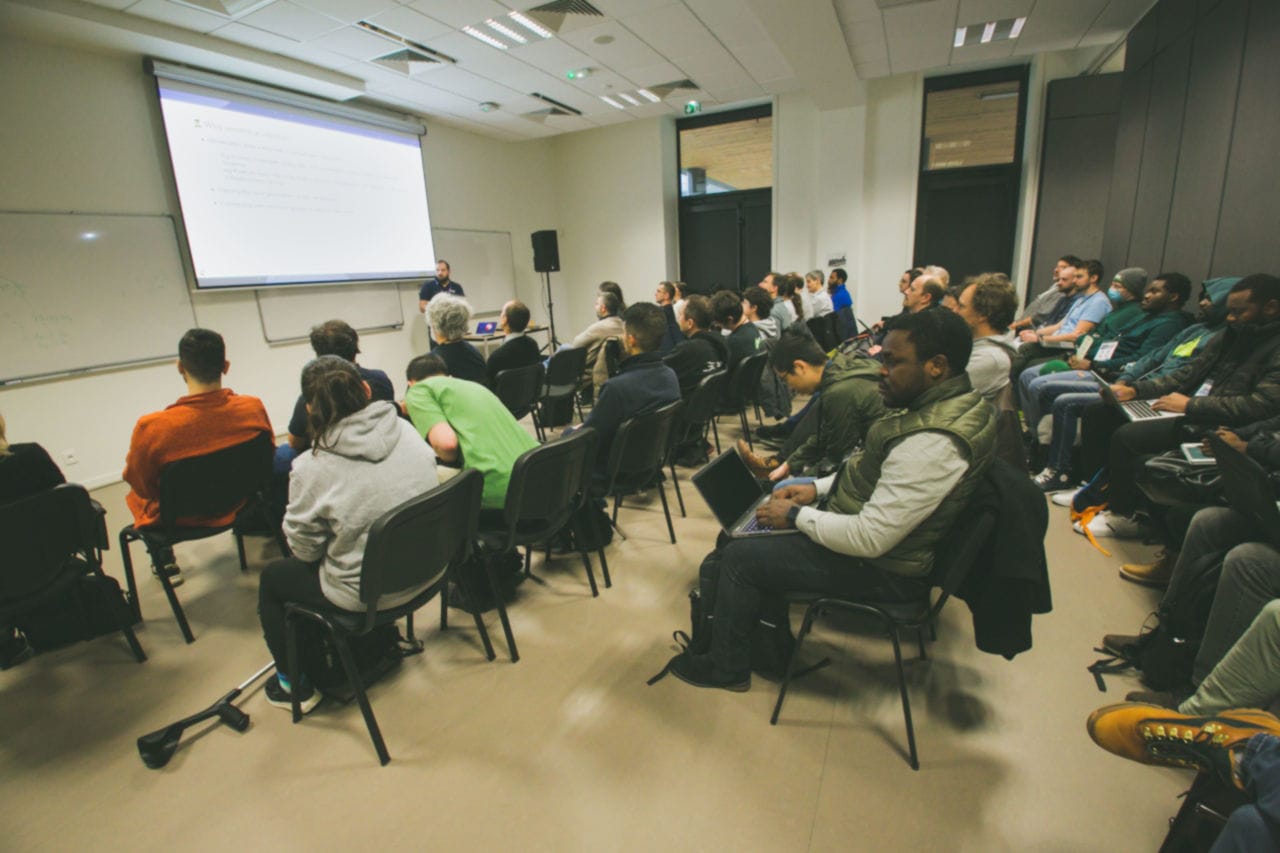
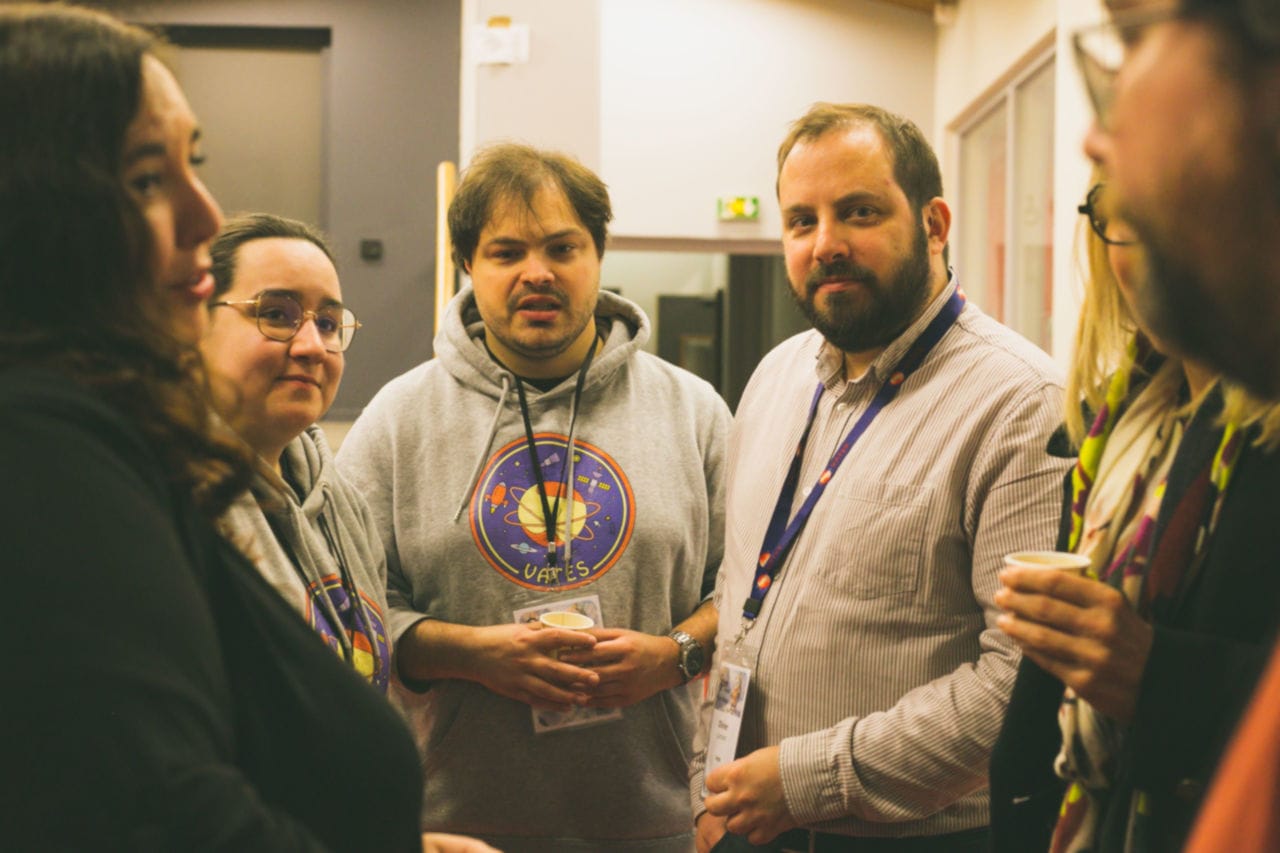
    We just wrapped up the Xen Winter Meetup 2025. It was an amazing opportunity to push Xen forward in a way that can only happen when people get together in person. Organized by Vates, we hosted it at the University of Grenoble IMAG building, a great spot for cutting-edge research in computer science and virtualization. Our goal? Accelerate Xen’s development, bring in fresh minds, and foster stronger ties between industry and academia.

    🐼 Why we did it

    The idea for this meetup started at the last Xen Summit, where a design session revealed how much progress can be made when we sit down and tackle challenges head-on. Xen Summit itself is fantastic, with deep technical talks and important roadmap discussions, but we wanted to take things further. There’s something special about in-person brainstorming that no online discussion can replace.

    We decided to double down on what makes the Xen community great: collaboration, innovation, and a shared passion for building a better virtualization stack. Furthermore, we found an opportunity to expand our reach. Xen needs more contributors. However, developers often don’t even realize they can get involved. By hosting this meetup, our objective was to make it easier for people—especially students and researchers—to step in, learn, and contribute.

    Grenoble was the perfect location to realize our objecctives. The city is home to some top-tier research teams, like KrakOS at LIG, who specialize in virtualization, OS design, and cloud infrastructure. We knew bringing Xen developers and researchers together would spark new ideas and open doors for up-and-coming contributors. With seasoned Xen devs mentoring newer ones, we’re keeping knowledge sharing alive and ensuring the stability of the project for years to come.

    alt
    The IMAG, home of the Xen Winter Meetup 2025 (Grenoble)

    A fully independent Xen meetup

    We also wanted to prove that a Xen-focused event could be community driven without high-cost partners while remaining accessible to all. Hosting it ourselves meant we had full control over the agenda, keeping the focus 100% on what benefits the Xen community. We didn’t need a huge budget: just amazing people with a shared commitment to making Xen better.

    ⏩ A packed but well-paced meetup

    We ran the Xen Winter Meetup over two days, striking a balance between structured sessions and free-flowing discussions. Mornings were packed with talks, where developers and researchers shared their latest work, while afternoons were all about design sessions: getting hands-on and tackling real technical challenges together.

    We were very pleased with the format. Too often conferences cram in endless back-to-back talks, leaving everyone mentally drained by the end of the day. We wanted something different, something that kept the energy high and made room for actual problem-solving. By keeping the mornings focused on presentations and reserving the afternoons for in-depth discussions, we avoided mental burnout and got the best of both worlds.

    The main talks

    Olivier kicked things off with a quick intro talk, covering why we organized this event and some logistics details.

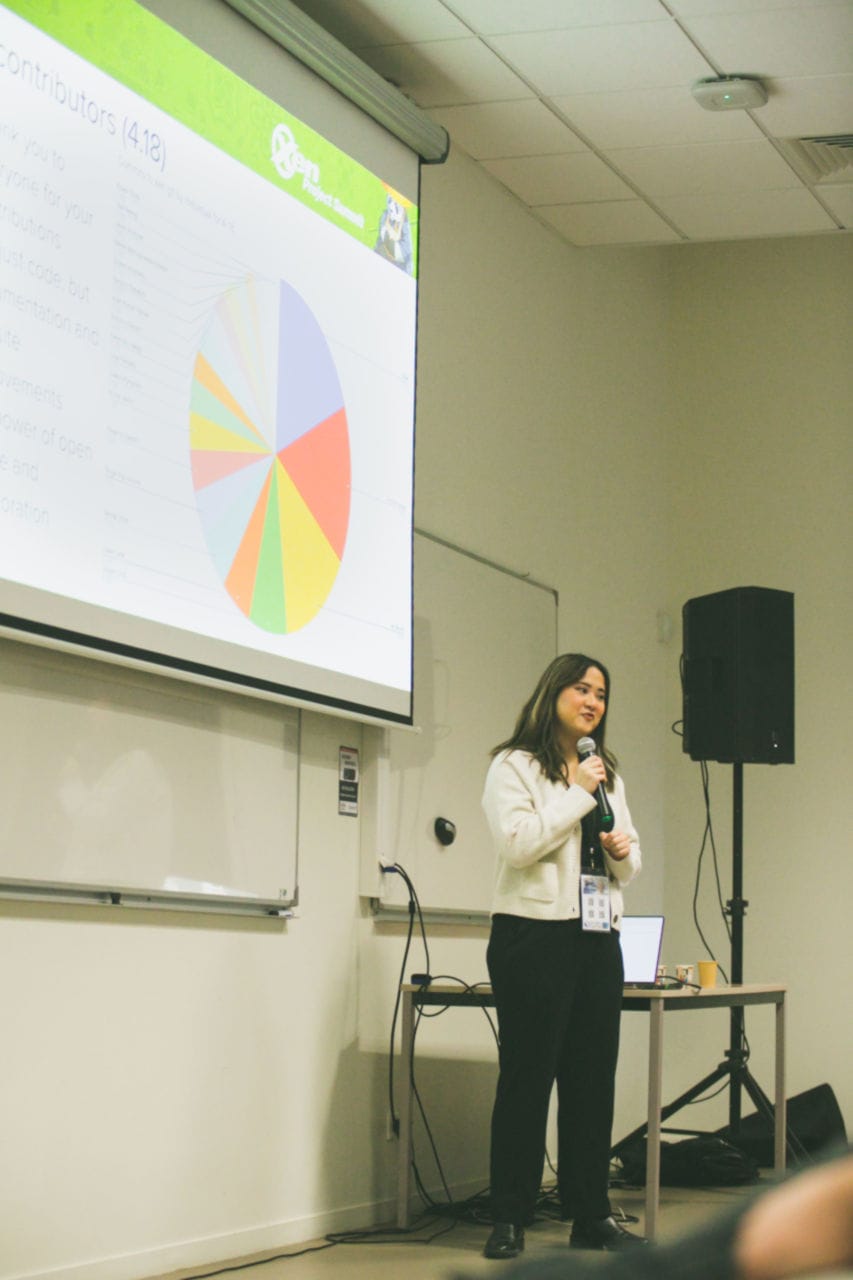
    From there, Kelly (Xen Community Manager) gave us a Xen Project weather report, looking at recent successes and transformations within the project. It was a great way to set the stage for what’s ahead and highlight how Xen continues to evolve.

    Then we got into the meaty technical talks. Teddy (Vates) gave an insightful presentation on Rust within the Xen Project, showcasing the work being done to bring memory safety and modern tooling into the hypervisor. Andrew (Citrix) followed with an overview of key improvements and opportunities in the Xen Hypervisor, essentially laying out a roadmap for where we need to focus our efforts in the coming months and years. This talk is definitely one to keep in mind, as it’s going to serve as a reference for major Xen development moving forward.

    Andrei (Vates) then took the stage to go over our progress on getting AMD SEV support into Xen, a critical piece for enhancing security and workload isolation. On Friday, Piotr (3MDeb) presented a fascinating talk on host Secure Boot for XCP-ng, showing how it can be done properly—and within a week, they already had a working proof of concept! It was really engaging to see just how thin the layers between hardware, firmware, and Xen/XCP-ng really are.

    We also had some great contributions from academia. Léo (University of Rennes) gave a talk about using Xen to analyze VM memory without being detected by malware—a true cat-and-mouse game between attackers and defenders. Caleb (University of Grenoble) followed with his research on Xen’s behavior when migrating between heterogeneous CPUs. This isn’t published yet, but once it is, we’ll definitely share more details in a future post!

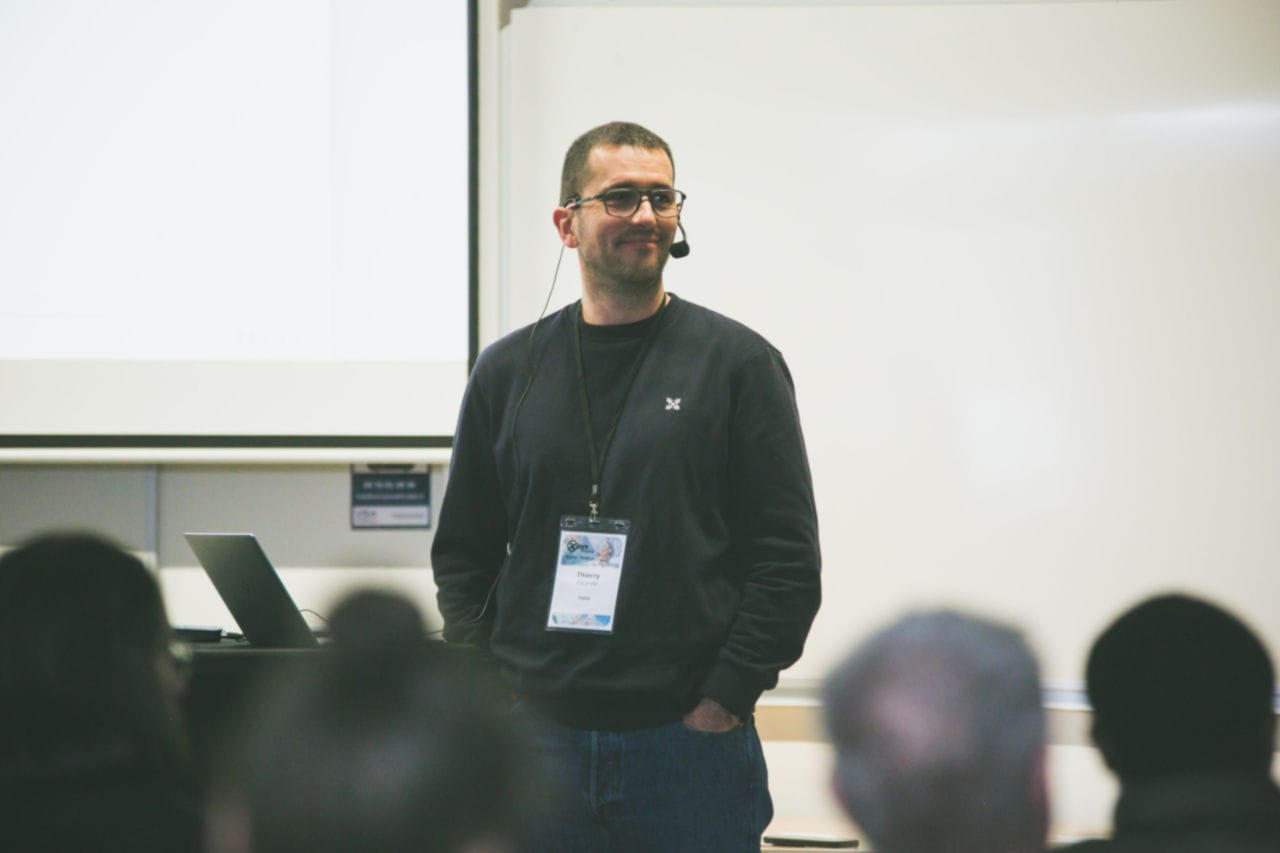
    Back to Xen development, Thierry (Vates) provided a recap of the Q35 work and what’s next, with some valuable insights from Andrew on key architectural decisions. Finally, Julien (Clever Cloud) wrapped up the talks with a real-world use case, showing how they use XCP-ng + Xen Orchestra (Vates VMS) in their PaaS platform, and how it could help businesses migrate away from VMware.

    Every talk brought something unique to the table, making it clear that Xen’s ecosystem is alive, evolving, and tackling exciting challenges head-on!

    Design sessions: an essential tool for collaboration

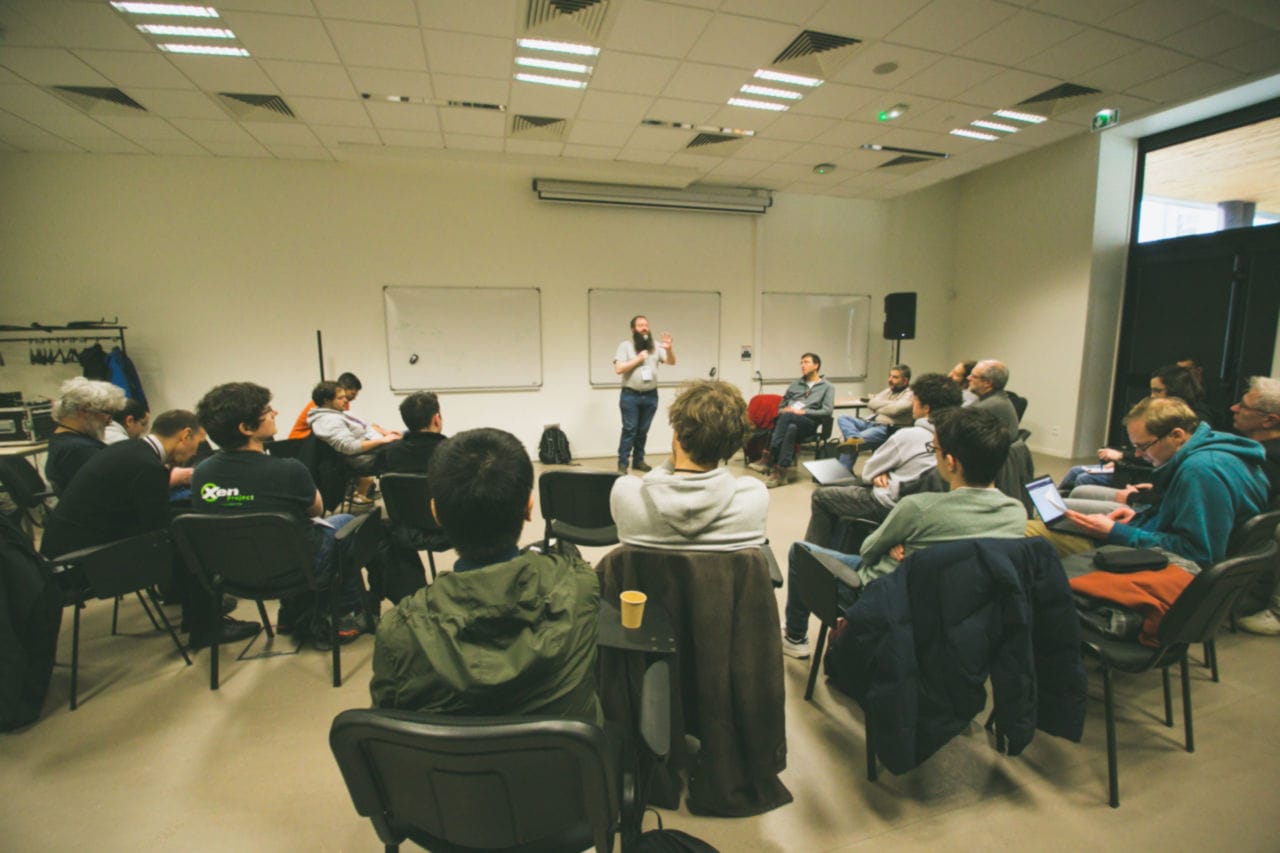
    One of the biggest strengths of this meetup was the design sessions. These weren’t just regular talks—they were interactive, hands-on discussions where we reconfigured the room, formed a big circle, grabbed a whiteboard, and got straight to problem-solving. This setup made a huge difference. Instead of just listening, everyone actively contributed to shaping Xen’s future, discussing architecture, features, and the next steps for key developments. All while leaving room to deep dive into any challenging topics.

    A lot of important topics were tackled: PVH virtualization mode, nested virtualization, and the Xen IOMMU we’re bringing upstream. The second day opened up even more diverse discussions, with a dedicated session on “Getting Started with Xen’s Codebase”, making it easier for newcomers to contribute, and another on “Strengthening Collaboration Between Xen and Academia”, which led to concrete action points.

    These sessions didn’t just help move technical topics forward—they helped build stronger relationships between teams from different companies and universities. And that’s the real magic of these events and the greater Xen community. When people connect and collaborate in person, the effects ripple far beyond the meetup itself. We believe the relationships built here will make upstream development smoother and more efficient, ensuring that Xen continues to evolve with input from a diverse and engaged community.

    It was also about cheese and computers

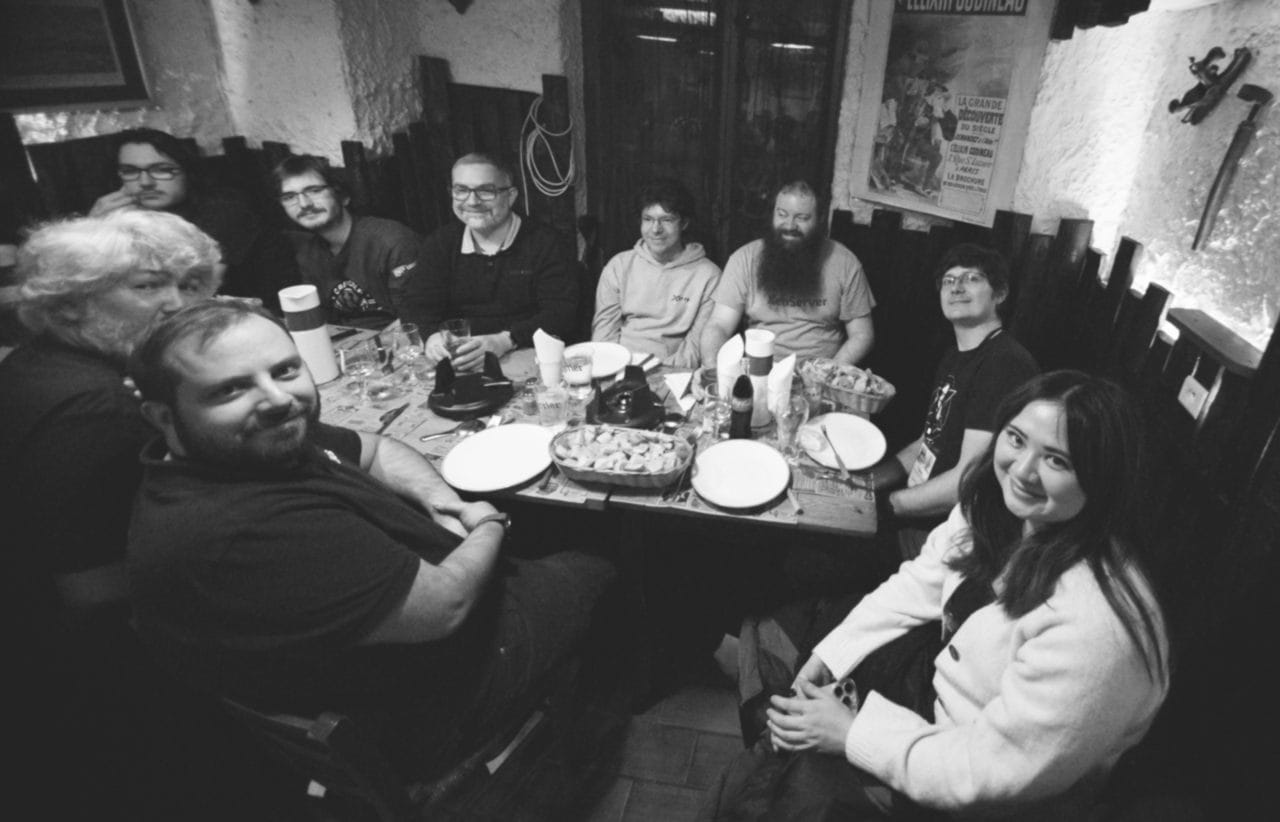
    A Winter Meetup in the Alps without cheese? Not happening. So, of course, we organized a proper fondue night, because what better way to wrap up intense discussions than by almost drowning in melted cheese (we survived… barely).

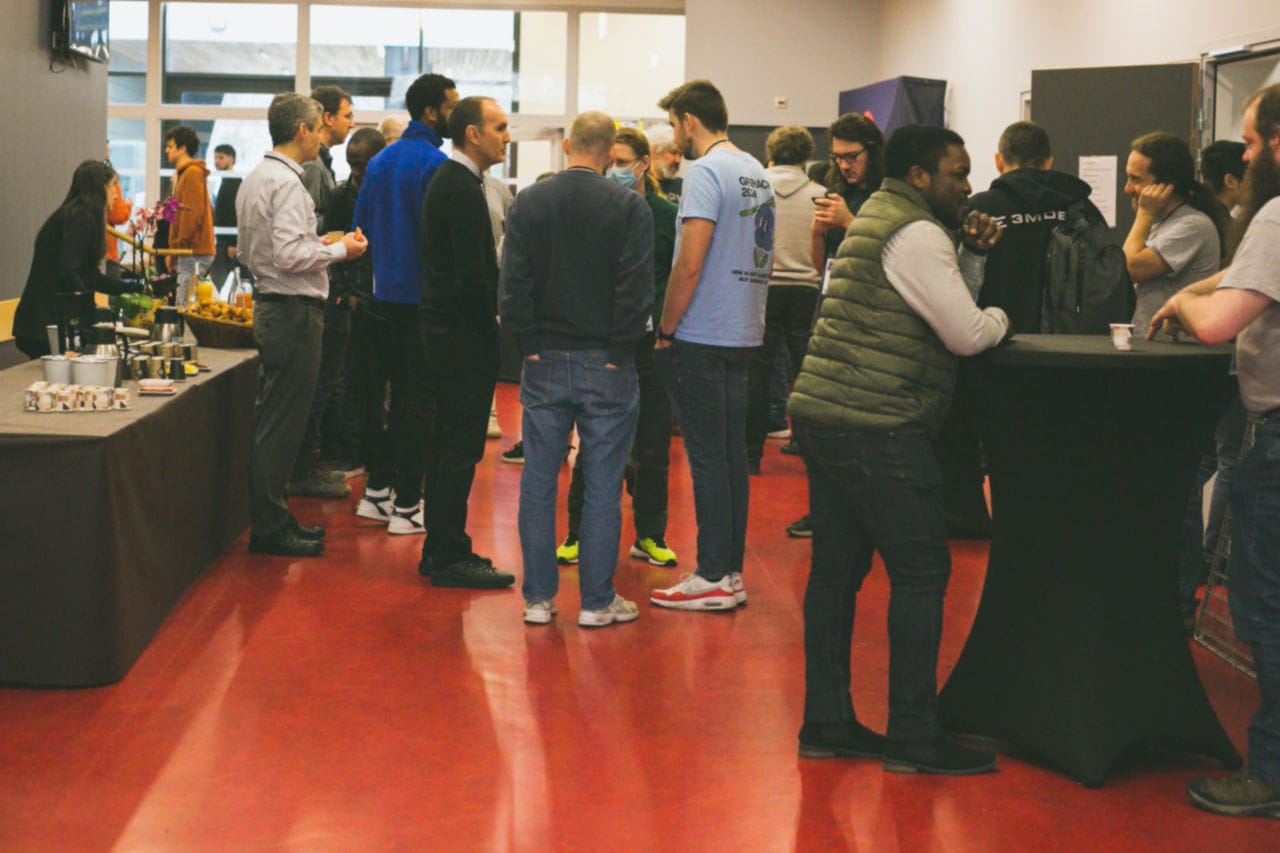
    These social moments are just as important as the technical ones. When you step away from deep-dive discussions and just hang out, real connections start to form. And that’s what makes long-term collaboration easier. When you’re working with people across time zones and only interacting through screens, having shared memories from a night like this changes everything. It’s no longer just “someone from another company” on the other side of an email—it’s someone you’ve had a laugh with, debated with, and maybe even fought over the last piece of bread.

    The Xen community is diverse and thriving. It's a place where folks from all walks of life can come together and work towards a common goal and passion. These special moments let this wide variety of folks connect and hopefully build lasting bonds. The community is welcoming and ready to accept new contributors!

    At the end of the day, these meetups aren’t just about code: they’re about strengthening the Xen community as a whole, and sometimes, all it takes is a good meal to turn colleagues into actual friends.

    alt
    One of four large tables, fully prepped and ready to welcome a serious cheese feast!

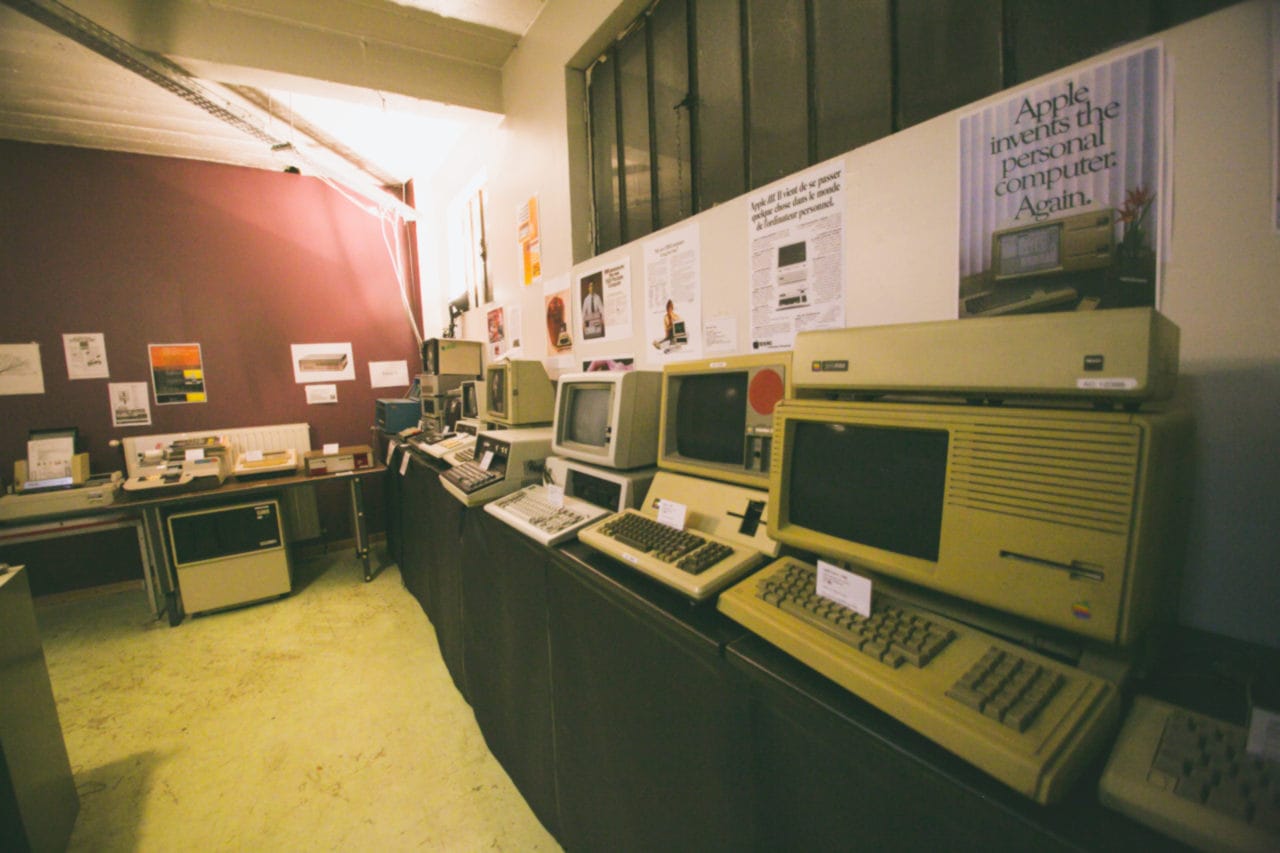
    What about computers, and very old ones? What’s a meetup full of virtualization and OS enthusiasts without a deep dive into computing history? We couldn’t pass up the chance to take everyone to ACONIT, home to one of the most incredible computer collections in the world.

    From the very first machines of the 19th century to rare and iconic hardware like mainframes, early IBM computers, analog machines, and legendary personal computers, the visit was a time-travel experience through the evolution of computing. Seeing these machines up close—some of which laid the groundwork for everything we work on today—was a humbling reminder of how far we’ve come.

    And let’s be honest, for a room full of tech people, this was geek heaven. It was another highlight of the meetup, adding a unique touch that made this gathering not just about Xen, but about celebrating the whole history of computing.

    🖥️
    A word on ACONIT:ACONIT, the Association for a Conservatory of Information Technology, founded in 1985 with principle objective of preserving the history of computing and creating tools to better understand and explain to the general public the risks and rewards of current developments in the information processing as it permeates deeper into society. You can read moreon their website.

    🎯 Our take on the meetup

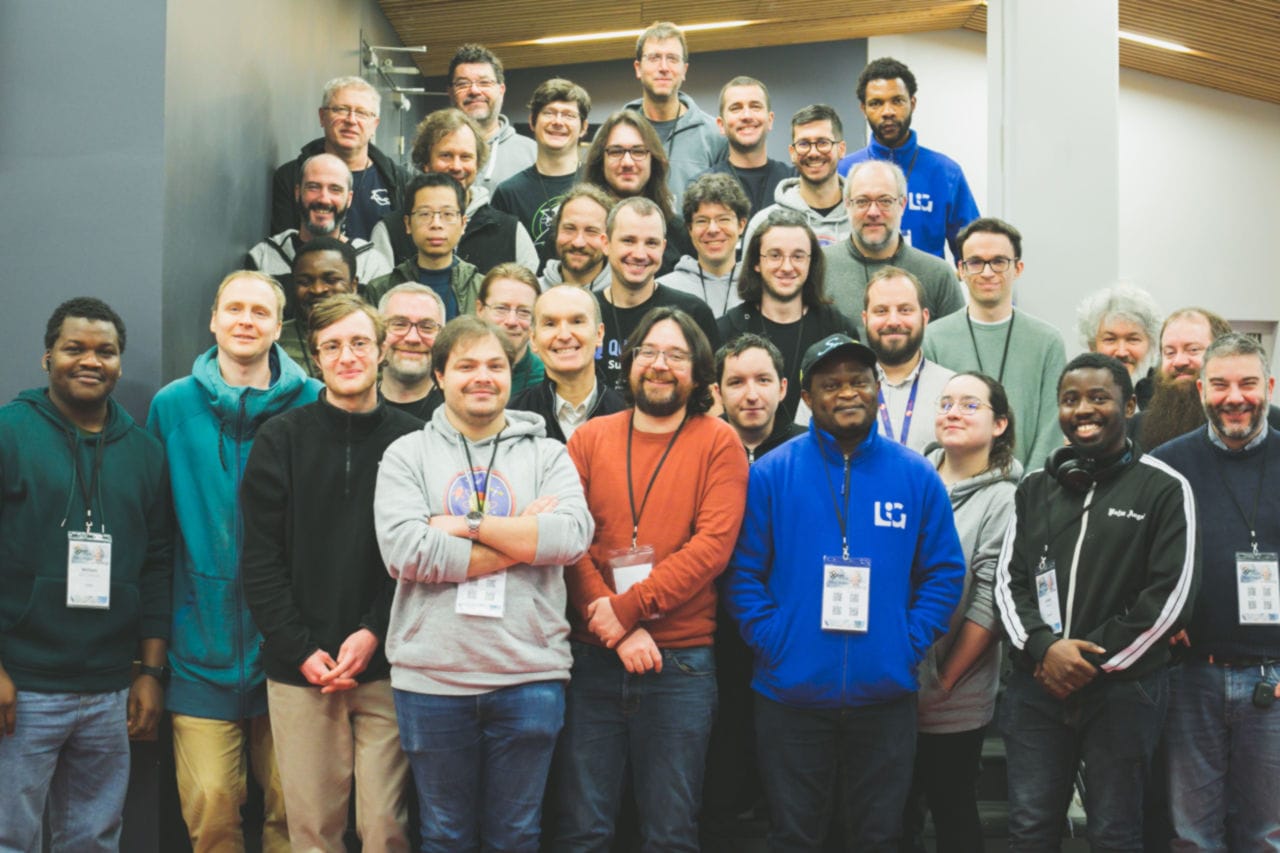
    First off—huge kudos to everyone who made this happen! A big thanks to all the attendees; nearly everyone who signed up showed up, despite flu season trying to mess with our numbers. Out of a max capacity of 50, we had 47 people in the room. That was seriously impressive for such a deep technical gathering in Grenoble.

    This wouldn’t have been possible without the University of Grenoble generously hosting us and, of course, the amazing Vates team, who made sure everything ran smoothly so that we could focus on discussions, not logistics.

    Beyond just being a great moment for the Xen community, this meetup proved something important: a Xen board member can organize a high-impact gathering at a very reasonable cost, all while accelerating real collaboration. No need for huge conference budgets—just the right people, the right topics, and a shared drive to move Xen forward.

    In the end, we achieved all of our goals. We brought more people together around Xen’s future, and the mix of attendees was incredible: IaaS providers, hardware manufacturers, academic researchers, software vendors, and experts—all in the same room, actively shaping what’s next.

    This wasn’t just a meetup. It was a step forward for Xen’s long-term success and we’re incredibly proud of what we built together.

    Thanks for coming and we look forward to the next meetup!

    alt

    Blog post content courtesy of Olivier Lambert, Vates.

  • Welcome Honda to the Xen Project Board 09 December

    Welcome Honda to the Xen Project Board

    We're excited to announce our newest Advisory Board Member Honda, to Xen Project.


    Since its foundation, Honda has been committed to "creating a society that is useful to people" by utilizing its technologies and ideas. Honda also focuses on environmental responsiveness and traffic safety, and continue to take on the challenge of realizing a sustainable future.

    I am sure that the community will agree that this is a huge step and achievement for our open source project. Honda's investment into supporting Xen means we are expanding our efforts to create a more secure and versatile hypervisor, with real world applications. Their commitment and partnership with Xen only increase the capabilities that our virtualization technology has achieved so far.

    With Honda joining, their insights will help us navigate new challenges, expand our outreach to new contributors and enhance policies surrounding our community.

    Their unique perspective will be invaluable as we tackle goals for the future, and we’re thrilled to have their voice guiding our strategy and vision.

    Please join us in giving a warm welcome to Honda! We’re eager to see how their leadership and technical teams will help shape the future of the Xen Project. Together, we’ll continue building a strong, inclusive, and innovative community.

    Kelly,

    Community Manager

  • Say hello to our new website 05 December

    Hello Xen Community,

    You may have noticed something different...

    We've refreshed our existing website!

    Xen Project New Website 2024

    Why did we do this?

    Well, all these new changes are part of an ongoing effort to increase our visibility and make it easier to find information on pages. We know how important it is for both users and wider stakeholders to learn about project, progress and ways to contribute.

    Our documentation will still link to our old wiki for now, as this is where most of our guides are stored. However, you might remember we are in the process of moving to Sphinx so we will eventually update the website once we have more content created. We welcome community members to contribute to this!

    Have fun exploring what's new on our website, and we hope to see you hang around our matrix channels. You'll find most of our developers and members there, and it's also a place to ask more questions.

    If you do have any feedback or notice errors, please feel free to reach out.

    Kelly,

    Community Manager